Tragacanth Gum: A B2B Buyer's Guide to Exporting Tragacanth to Germany
Tragacanth Gum is a natural plant-derived hydrocolloid used in selected food, pharmaceutical, cosmetic, and industrial applications. For German importers and international ingredient buyers, purchasing this material requires more than comparing quotations. Buyers need to understand the product's botanical identity, commercial form, functional characteristics, quality documentation, and suitability for the intended application.
For businesses sourcing Tragacanth internationally, choosing an appropriate supplier is an important part of procurement planning. Differences in product form, physical characteristics, analytical specifications, packaging, and documentation can affect how a shipment is evaluated and whether the material meets the buyer's requirements.
Pars Ketira supplies and exports Tragacanth Gum, including stick-type and granular or cluster-type products, subject to actual product availability. Buyers considering a purchase should confirm the available form, grade, technical specifications, order requirements, and applicable export arrangements before placing an order.
This guide explains how Tragacanth Gum is identified, how buyers can assess its suitability, and which commercial and regulatory questions deserve attention when sourcing the ingredient for Germany. It also outlines the information importers should request before comparing suppliers or preparing a purchase order.
1. Understanding Tragacanth Gum
1.1 What Is Tragacanth Gum?
Tragacanth Gum is a dried plant exudate obtained from the stems and branches of certain species of Astragalus. It is composed mainly of complex, high-molecular-weight polysaccharides. The European Union's specifications for the food additive E 413 describe Tragacanth as a dried exudate obtained from Astragalus gummifer and other Asiatic species of Astragalus.
Unlike synthetic polymers, Tragacanth Gum originates from plant material. Its commercial value comes from its ability to interact with water and develop a viscous mucilage. Depending on the material's characteristics and the conditions of use, it can contribute to thickening, suspension, stabilization, and texture modification in suitable formulations.
These properties make Tragacanth relevant to buyers seeking a botanical gum for a defined technical purpose. However, natural origin alone does not establish that a material is suitable for food, pharmaceutical, cosmetic, or other regulated applications. The product must meet the specifications and regulatory conditions applicable to its intended use.
For regulatory reference, buyers can consult the EU's consolidated specifications for food additives, including E 413 Tragacanth. This reference is particularly relevant when assessing material intended for use as a food additive. It should not be interpreted as automatic approval of every commercial grade for every application.
1.2 Botanical Origin and Natural Composition
Tragacanth is associated with plant species in the genus Astragalus, which belongs to the legume family. The gum forms as an exudate from the plant and is collected and prepared for commercial use. The botanical source and the way the collected material is handled can influence the characteristics of the resulting commercial product.
From a procurement perspective, buyers should distinguish between the general botanical identity of Tragacanth and the verified identity of a particular shipment. A product description can identify the material by its common name, but a commercial specification should provide sufficient information to establish what is being supplied.
When evaluating a supplier, request the product's declared identity and available technical documentation. If botanical authentication, analytical testing, or other evidence is necessary for the intended application, establish those requirements before confirming the order.
Buyers should also avoid treating all naturally derived gums as interchangeable. Tragacanth Gum, gum arabic, guar gum, xanthan gum, and other hydrocolloids differ in origin, composition, functional behavior, and regulatory status. A substitute should be selected only after the relevant formulation and performance requirements have been assessed.
1.3 Important Physical and Functional Characteristics
One of the defining characteristics of Tragacanth Gum is its interaction with water. Under suitable conditions, it swells and forms a viscous mucilage. The resulting behavior depends on the characteristics of the material, the amount used, preparation conditions, and the composition of the surrounding formulation.
Tragacanth should not be described simply as a gum that dissolves completely in water. Its behavior is more accurately understood in terms of hydration, swelling, and mucilage formation. Buyers who need a predictable processing result should assess the material under conditions representative of their actual application.
Relevant characteristics may include:
- Physical form: The supplied material may consist of recognizable gum fragments, sticks, granules, clusters, or another declared commercial form.
- Appearance: Color and physical appearance can help with preliminary inspection, but appearance alone cannot establish identity, purity, or application suitability.
- Hydration behavior: The way the material swells and develops mucilage may influence preparation and processing.
- Viscosity: The viscosity of a prepared system depends on the material and test conditions. A meaningful comparison requires a defined testing method and concentration.
- Foreign matter and cleanliness: The acceptable limits depend on the agreed specification and intended use.
- Moisture and other analytical parameters: These should be evaluated against the relevant product specification or applicable regulatory standard.
These characteristics are useful starting points for technical discussions, not a substitute for a verified specification. No particular viscosity, moisture level, purity percentage, or shelf life should be assumed without supporting product documentation.
1.4 Why Product Identity and Grade Matter to Buyers
The term “Tragacanth Gum” identifies a general class of material, but it does not communicate every detail needed for a purchasing decision. Two commercial offerings described by the same common name may differ in physical form, grading, preparation, analytical characteristics, or suitability for a particular process.
For example, a buyer who needs recognizable gum pieces for further processing has a different purchasing requirement from a manufacturer that needs a material meeting a defined particle-size specification. Similarly, a business purchasing an ingredient for a regulated food application must assess the applicable food requirements rather than relying only on a general commercial description.
Before requesting a quotation, buyers should establish the intended use and identify the essential product requirements. These may include:
- The required commercial form or grade.
- The intended application and processing conditions.
- Any required technical specification or test method.
- Applicable contaminant and microbiological criteria.
- Required batch identification and traceability information.
- Packaging, transport, and storage requirements.
- Documents that must accompany the shipment or be available before dispatch.
This approach helps suppliers respond to a clearly defined inquiry and makes quotations easier to compare. It also reduces the risk of purchasing a product that is correctly described by its general name but unsuitable for the buyer's actual process.
1.5 Tragacanth Gum in the Context of International B2B Purchasing
International procurement involves several separate assessments. The first is product identity: is the material actually the gum the buyer intends to purchase? The second is technical suitability: does the product meet the required performance and quality criteria? The third is commercial suitability: can the supplier offer acceptable packaging, quantities, documentation, and delivery terms? For regulated applications, a further assessment is needed to establish whether the product and proposed use comply with the applicable rules.
For German buyers, these questions should be addressed before the shipment is finalized. Where the gum is intended for use as a food additive, the relevant EU food-additive specifications and applicable food-law requirements must be considered. Where it is intended for cosmetics, pharmaceuticals, or industrial processes, the requirements may be different and must be assessed according to the actual use.
The European Commission explains that EU food law includes requirements for food safety and traceability, with responsibilities applying to food business operators throughout the supply chain. Importers should therefore ensure that the information and documentation associated with a food ingredient are appropriate for their role and the product concerned.
See the European Commission's guidance on general EU food-law requirements and traceability for further information.
📌 Practical Tip for Importers
Prepare a written product specification before comparing offers for Tragacanth Gum. Include the intended application, required commercial form, essential analytical parameters, order quantity, destination, packaging requirements, and requested documents. Ask each supplier to confirm which requirements it can substantiate for the proposed product.
1.6 Initial Buyer Checklist
Use the following checklist as a starting point when evaluating Tragacanth Gum for a potential purchase.
| Evaluation Area |
What to Establish |
Recommended Action |
| Product identity |
Declared material and botanical identity, where relevant |
Request the product specification and available identity documentation |
| Commercial form |
Stick-type, granular, cluster-type, or another specified form |
Confirm actual availability before ordering |
| Technical suitability |
Performance and quality requirements for the intended process |
Agree on measurable specifications and test methods |
| Regulatory suitability |
Requirements associated with the destination and intended use |
Verify applicable rules before shipment |
| Documentation |
Technical data, analytical records, and traceability information |
Identify required documents and confirm their availability |
| Commercial terms |
Quantity, packaging, destination, and delivery arrangements |
Request a quotation based on the complete purchasing brief |
1.7 What Buyers Should Confirm Before Moving Forward
The most useful first step is to define what the business needs the gum to do. A general inquiry such as “Please quote Tragacanth Gum” may not provide enough information to establish whether the proposed product is suitable or to prepare a directly comparable quotation.
A more useful inquiry identifies the intended application, required form, quantity, destination in Germany or elsewhere, technical specifications, packaging preferences, and documentation requirements. Buyers should also explain whether the product is intended for food use or another regulated application, because this can materially affect the evaluation process.
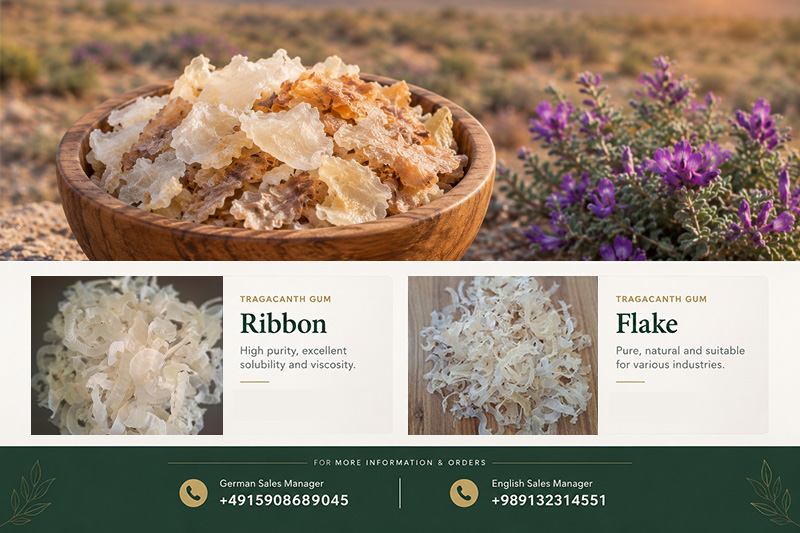
Pars Ketira can be approached to discuss the required product form and purchasing specifications. Availability, product-specific properties, documentation, and commercial terms should be confirmed directly before an order is placed.
Suggested next step: Review the relevant product information at Pars Ketira's product pages and identify the specifications needed for your intended application. If a required detail is not published, request confirmation rather than assuming it applies to every grade.
End of Section 1. The next section will cover commercial forms, grades, and application suitability.
Selecting the right form of Tragacanth Gum is an important step for importers, distributors, and industrial buyers. Commercial form affects how a material is inspected, handled, stored, sampled, and prepared for further processing. However, physical appearance alone does not establish functional performance or regulatory suitability.
For businesses sourcing Tragacanth Gum for Germany, product selection should begin with the intended application and the technical requirements associated with it. A buyer who needs recognizable gum pieces may have different requirements from a manufacturer that needs a controlled particle size or a documented functional performance.
Pars Ketira supplies stick-type and granular or cluster-type Tragacanth Gum, subject to actual product availability. Buyers should confirm the available commercial forms and grades directly before placing an order. The terms used in this section describe general purchasing considerations, not a guarantee that every form or specification is currently available.
2.1 Stick-Type Tragacanth Gum
Stick-type Tragacanth Gum is a commercial form presented as elongated or stick-like pieces. This form may be relevant to buyers who prefer to inspect recognizable pieces of the raw gum before further preparation or processing.
For wholesalers and ingredient distributors, the visible form can be useful during preliminary sorting and visual inspection. Nevertheless, visual appearance is only one part of quality assessment. It cannot independently establish botanical identity, purity, contaminant levels, functional properties, or compliance with a specific regulatory standard.
Before purchasing stick-type material, buyers should establish the following points:
- Physical consistency: Confirm the expected size, shape, and acceptable variation of the supplied pieces.
- Visual acceptance criteria: Define acceptable color variation and the procedure for assessing foreign matter.
- Cleanliness: Establish the applicable requirements for extraneous material and handling.
- Technical requirements: Request analytical specifications relevant to the intended application.
- Packaging: Confirm how the product will be packed, protected, identified, and prepared for transport.
- Traceability: Establish how the shipment and individual lots or batches will be identified, where applicable.
These points are particularly useful when the buyer needs to compare quotations from different suppliers. A quotation that merely names the product may not specify the physical acceptance criteria or the supporting documents required for a purchase.
Stick-type Tragacanth should not automatically be considered superior to granular or cluster-type material. The appropriate choice depends on the buyer's inspection process, handling requirements, preparation method, and agreed specification.
2.2 Granular or Cluster-Type Tragacanth Gum
Granular or cluster-type Tragacanth Gum refers to material supplied in granular pieces or naturally occurring clusters, according to the commercial description agreed with the supplier. Buyers should clarify the precise meaning of these terms because commercial naming conventions do not necessarily represent a standardized particle-size classification.
The distinction matters when a buyer requires a relatively consistent physical form for packing, inspection, processing, or subsequent size reduction. A description such as “granular” does not, by itself, establish a particular mesh size, particle-size distribution, moisture content, or functional performance.
Before selecting this form, procurement teams should ask:
- How is the commercial form defined in the supplier's specification?
- Are there agreed limits for piece size or particle-size distribution?
- Does the buyer require intact clusters, smaller pieces, or a controlled size range?
- What analytical and visual quality parameters apply to the product?
- Is the material intended for further processing before use?
- Can the supplier provide documentation for the exact product being quoted?
These questions help ensure that the physical description corresponds to the buyer's actual requirements. Where particle size is critical, it should be defined using an agreed measurement or grading method rather than a broad commercial label.
As with stick-type material, suitability for food, pharmaceutical, cosmetic, or industrial applications must be assessed separately. A particular physical form does not automatically establish the required grade or demonstrate compliance with the rules governing the final application.
2.3 Comparing the Main Commercial Forms
The following table provides a preliminary purchasing comparison. It is a decision aid rather than a verified product specification for an individual Pars Ketira shipment.
| Comparison Factor |
Stick-Type |
Granular or Cluster-Type |
| Physical appearance |
Elongated or stick-like pieces |
Granular pieces or clusters, as specified |
| Initial inspection |
Visual examination of individual pieces |
Examination of the supplied pieces or clusters |
| Size requirements |
Define acceptable piece dimensions and variation |
Clarify the meaning of granular or cluster and any size limits |
| Processing considerations |
Assess the buyer's preparation and handling method |
Assess the buyer's preparation and handling method |
| Quality verification |
Use the agreed specification and relevant tests |
Use the agreed specification and relevant tests |
| Best selection approach |
Choose when this form matches the buyer's documented requirements |
Choose when this form matches the buyer's documented requirements |
💡 Buyer Recommendation
When requesting a quotation, describe the required physical form and acceptance criteria separately from the intended application. This makes it easier to identify whether a proposed product matches the purchasing specification without confusing appearance with grade or performance.
2.4 What Does a Tragacanth Gum Grade Mean?
The word “grade” can refer to different things in commercial discussions. It may describe a supplier's internal product category, a physical classification, a quality specification, or a material intended for a particular application. These meanings are not interchangeable.
For international purchasing, the buyer should ask the supplier to define the grade in measurable or otherwise verifiable terms. A grade name alone is insufficient when the purchase depends on specific analytical results, functional behavior, or compliance requirements.
A useful specification may address several distinct areas:
- Identity: The declared material and any applicable identification requirements.
- Physical characteristics: Form, appearance, and any agreed size classification.
- Analytical parameters: Relevant test results and acceptance limits.
- Functional performance: Requirements for hydration, viscosity, or other properties where these are important to the buyer.
- Contaminant controls: Applicable limits and testing expectations for the intended use.
- Regulatory suitability: Evidence needed to assess compliance with the rules applicable to the product and its use.
Not every purchase requires the same level of testing or documentation. A buyer procuring material for further industrial evaluation may have different requirements from a company purchasing an ingredient for a regulated food application. The specification should reflect the actual risk, use, and applicable rules.
2.5 Food-Grade Tragacanth Gum: What Buyers Should Verify
Businesses considering Tragacanth Gum for food applications should distinguish between a product being described commercially as “food grade” and documented evidence that it meets the applicable requirements for the intended use.
In the European Union, Tragacanth is identified as food additive E 413. The applicable specifications and conditions of use must be evaluated against current EU legislation. The legal status of the ingredient, the permitted use, and any restrictions or conditions depend on the relevant regulatory framework.
Before purchasing Tragacanth Gum for a food-related application in Germany, buyers should consider:
- Whether the intended use is permitted under the applicable EU food-additive rules.
- Whether the product meets the relevant identity and purity specifications.
- Which analytical and contaminant requirements apply.
- Whether appropriate lot identification and traceability records are available.
- Whether the product documentation supports the intended food application.
- Whether additional customer-specific requirements apply to the finished product or manufacturing process.
Buyers should consult the EU specifications for food additives and verify the applicable consolidated legislation before making a regulatory decision. Supplier documentation supports this assessment but does not replace the buyer's responsibility to establish that the proposed use is lawful.
It is also important not to assume that material suitable for one food application will automatically satisfy every other food formulation. Processing conditions, customer specifications, and the characteristics of the finished product can create additional requirements.
2.6 Pharmaceutical and Nutraceutical Applications
Tragacanth has a history of use in certain pharmaceutical formulations, where its functional properties may be relevant to formulation development. However, a commercial supply of raw Tragacanth Gum should not automatically be described as suitable for pharmaceutical manufacture.
Pharmaceutical buyers may need to assess requirements relating to identity, purity, impurities, microbiological quality, testing methods, traceability, and applicable pharmacopoeial or other recognized standards. The specific requirements depend on the intended use, jurisdiction, and quality system of the purchasing organization.
Nutraceutical applications also require careful evaluation. The fact that a material is botanical or has a history of use does not independently establish that it is permitted or suitable for every supplement, dosage form, or intended claim.
Before entering into a pharmaceutical or nutraceutical supply arrangement, procurement and quality teams should confirm:
- The exact intended use and applicable regulatory framework.
- The required material specification and test methods.
- The documentation and traceability needed by the quality system.
- Any necessary evidence of compliance with relevant standards.
- Whether the supplier can substantiate the requirements for the specific product offered.
Do not rely solely on a general product brochure or verbal assurance. Where the required grade or compliance status has not been verified, obtain written confirmation before proceeding.
2.7 Cosmetic Applications
Tragacanth may be considered in selected cosmetic formulations where a botanical gum's thickening or texture-modifying properties are relevant. The suitability of a particular material depends on the formulation, desired performance, quality requirements, and applicable cosmetic regulations.
Cosmetic ingredient buyers should confirm the material's identity, physical characteristics, impurity controls, microbiological expectations, packaging, and traceability. They should also establish whether the documentation available is sufficient for the manufacturer's ingredient assessment and product compliance process.
A supplier's general description of a gum as natural does not establish that it is suitable for a finished cosmetic product. Compatibility testing and formulation evaluation may still be required by the manufacturer.
2.8 Industrial Applications
Some industrial formulations use natural gums for functions such as thickening, suspension, or modification of material behavior. Whether Tragacanth is suitable depends on the specific process and the performance required.
Industrial buyers should define the target function rather than selecting a material based on its name alone. Depending on the application, relevant evaluation criteria might include the material's behavior during mixing, hydration characteristics, consistency, compatibility with other ingredients, and stability under the process conditions.
Where performance is critical, a technical evaluation should use a defined method and representative processing conditions. Results obtained at one concentration or under one preparation method should not be assumed to apply universally.
Buyers should also determine whether the material is required to meet any sector-specific restrictions. A grade intended for an industrial process should not be presumed suitable for food, pharmaceutical, cosmetic, or other regulated use without appropriate verification.
2.9 How to Match a Product Form to the Intended Application
The following decision matrix helps procurement teams organize their initial assessment. It does not assign a guaranteed application to either stick-type or granular or cluster-type Tragacanth Gum. The actual product must be assessed against the buyer's requirements.
| Buyer Requirement |
Key Question |
Verification Step |
| Wholesale distribution |
Does the physical form meet customer expectations? |
Confirm grade description, appearance criteria, packaging, and lot identification |
| Food manufacturing |
Does the material meet the applicable food requirements and intended-use conditions? |
Review relevant legislation and product-specific analytical documentation |
| Pharmaceutical formulation |
Does the material meet the required quality standard? |
Confirm the specification, testing requirements, and applicable quality documentation |
| Cosmetic formulation |
Is the material appropriate for the formulation and compliance process? |
Assess ingredient identity, quality, compatibility, and regulatory needs |
| Industrial processing |
Does the gum provide the required function under process conditions? |
Define performance criteria and evaluate using a suitable test method |
| Further processing |
Does the supplied form match the next processing stage? |
Confirm size, handling, preparation, and acceptance requirements |
2.10 Common Mistakes When Selecting Tragacanth Gum
Several avoidable purchasing mistakes arise when buyers rely on broad product labels instead of defined requirements.
Mistake 1: Treating commercial form as a quality grade. A stick-like, granular, or cluster-like appearance does not establish purity, functional performance, or regulatory suitability.
Mistake 2: Assuming every natural gum is interchangeable. Tragacanth, guar gum, gum arabic, and xanthan gum have different properties. Substitution should be based on technical evaluation, not simply on the fact that all are gums.
Mistake 3: Requesting a quotation without a specification. When buyers do not identify the required form, quality parameters, quantity, and intended use, supplier offers may not be directly comparable.
Mistake 4: Assuming a general grade description proves compliance. Terms such as “premium,” “natural,” or “food grade” should not replace verifiable specifications and appropriate documentation.
Mistake 5: Leaving regulatory checks until after shipment preparation. Import requirements should be assessed early enough to identify missing documents or product suitability issues before dispatch.
Mistake 6: Ignoring the finished application. A material may meet a general product description but still fail to meet the technical needs of a specific formulation or process.
⚠ Important Warning
Do not approve a purchase solely on the basis of photographs, appearance, or an informal grade name. Agree on the product identity, specification, acceptance criteria, required documents, and intended use before confirming the order.
2.11 Product Selection Checklist for German Importers
Before contacting a supplier, German importers can prepare a concise technical brief covering the following points:
- Required commercial form and any acceptable alternatives.
- Intended application and relevant processing conditions.
- Required product specification and test methods.
- Any applicable EU or German regulatory requirements.
- Required analytical documents and traceability information.
- Packaging and transport considerations.
- Estimated order quantity and delivery destination.
- Required delivery terms and preferred shipment arrangements.
- Any customer-specific quality requirements.
This information helps establish whether the proposed product can meet the buyer's requirements and provides a clearer basis for commercial comparison. It also gives the supplier an opportunity to identify missing information before a quotation or shipment commitment is made.
2.12 Discuss Your Tragacanth Gum Requirements with Pars Ketira
Businesses interested in sourcing Tragacanth Gum for Germany or other international markets should identify their required product form, application, quantity, and technical criteria before requesting a quotation. Availability, specifications, packaging, supporting documentation, and delivery arrangements must be confirmed for the particular order.
For German buyers, the German Sales Manager is the primary contact for discussing purchasing requirements and export inquiries. International buyers communicating in English can contact the English Sales Manager.
Looking for a Tragacanth Gum Export Supplier for Germany?
Contact our sales team to discuss product specifications, available grades, documentation, and your purchasing requirements.

For further product information, visit the Pars Ketira product pages. Confirm the current product offering and the details relevant to your intended application before placing an order.
End of Section 2.
4. Tragacanth Gum Technical Specifications and Quality Documentation
Technical specifications are essential when purchasing Tragacanth Gum for international distribution or industrial use. They establish the characteristics a buyer expects, provide a basis for evaluating the supplier's offer, and help determine whether the proposed material is appropriate for the intended application.
For German importers, specifications also support communication between procurement teams, quality departments, customs representatives, and downstream customers. Where the material is intended for a regulated application, the technical review must be aligned with the applicable legal requirements and the buyer's own quality system.
A product description or commercial grade name is not a substitute for a documented specification. Buyers should request information relevant to the particular product and confirm which parameters are measured, which are guaranteed contractually, and which require separate verification.
4.1 What Should a Tragacanth Gum Specification Include?
A technical specification describes the material and identifies the parameters used to assess whether it meets the agreed requirements. The exact contents depend on the commercial form, intended application, regulatory framework, and level of quality control required by the buyer.
For an initial assessment, buyers can request information covering the following areas:
- Product identity: The declared material name and relevant botanical or analytical identification information.
- Commercial form: A clear description of the supplied material, such as stick-type, granular, or cluster-type Tragacanth Gum.
- Physical characteristics: Appearance and any specified size or grading criteria.
- Moisture: The measured or specified moisture parameter, where relevant to the product and application.
- Ash and other analytical parameters: Values required by the applicable standard or agreed product specification.
- Functional characteristics: Hydration, viscosity, or other performance measures when relevant to the intended process.
- Contaminant requirements: Applicable chemical, physical, and microbiological criteria.
- Traceability: Product, lot, or batch identification information appropriate to the transaction.
- Storage and handling: Relevant precautions and conditions supported by product information.
- Documentation: Available technical data, analytical reports, and other records required for the purchase.
This list is a framework for a purchasing discussion, not a claim that every listed parameter has a published value for every Pars Ketira product. The supplier should confirm the actual specification for the product being offered.
4.2 Product Identity and Botanical Authentication
Product identity is the starting point for any meaningful quality assessment. Buyers need to establish that the material being offered corresponds to the declared product and meets the identity criteria relevant to its intended use.
For Tragacanth Gum intended for use as EU food additive E 413, the applicable EU specifications should be consulted to identify the relevant definition, identification criteria, and purity requirements. Other applications may involve different technical standards or documentation requirements.
When reviewing product identity, buyers should distinguish between a commercial name, a botanical declaration, and the analytical evidence used to support identity. The appropriate level of verification depends on the purchase specification, the risks associated with the application, and any applicable legal requirements.
If identity is a critical acceptance criterion, specify how it must be demonstrated. The agreed approach may involve documentation, a suitable analytical method, or independent testing, depending on the circumstances.
4.3 Appearance, Color, and Physical Form
Visual inspection can be useful when receiving natural gums. Buyers may inspect the product's appearance, physical form, visible foreign matter, and consistency with an agreed reference or specification.
However, natural variation means that appearance should be assessed against clearly defined acceptance criteria. A particular color or shape does not independently prove purity, authenticity, microbiological safety, or compliance with an intended-use standard.
Where appearance is commercially important, buyers should establish:
- The expected physical form and acceptable variation.
- Any agreed visual criteria for color or general appearance.
- How foreign matter is assessed and recorded.
- The sampling and inspection method used for incoming material.
- The procedure for documenting a discrepancy between the supplied product and the agreed specification.
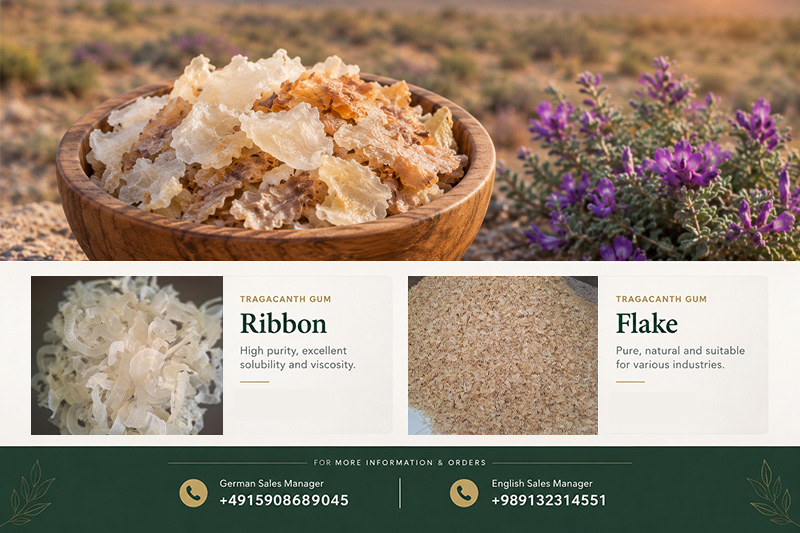
Photographs may help with preliminary discussions, but they should not replace appropriate inspection or analytical verification where those controls are required.
4.4 Moisture and Storage-Related Quality Parameters
Moisture is one of the parameters buyers may need to assess when purchasing and storing botanical gums. Its importance depends on the material, the applicable specification, the packaging system, and the expected storage and transport conditions.
Excess moisture or exposure to unsuitable storage conditions may affect product condition and can create quality concerns. Nevertheless, buyers should not apply an arbitrary moisture limit without confirming the appropriate standard or agreed specification for the product.
Before ordering, ask the supplier whether moisture is included in the product specification, how it is measured, and whether a relevant result is available for the offered material. Where moisture is an acceptance criterion, the purchase documents should identify the test method and the agreed limit.
Buyers should also consider the entire supply chain. Packaging, warehouse conditions, shipment duration, and exposure to humidity may influence how well the material is protected during handling and transport. These issues should be discussed as part of the packaging and storage plan rather than treated as a substitute for analytical testing.
4.5 Ash, Purity, and Other Analytical Parameters
Depending on the intended use and applicable specification, buyers may need information about ash content, purity-related criteria, and other analytical parameters. These measurements must be interpreted according to the relevant method and standard.
Terms such as “high purity” or “premium grade” should be supported by a clear definition if they are being used as purchasing criteria. Without a stated parameter and method, such descriptions may be difficult to compare across suppliers.
For a regulated application, the buyer should identify the applicable legal specification and confirm how compliance will be demonstrated. For a non-regulated industrial application, the buyer may instead define a technical specification based on the performance and quality requirements of the process.
Do not assume that a parameter relevant to one application is automatically required in the same form for every other application. The specification should be proportionate to the product, use, and relevant quality risks.
4.6 Viscosity, Hydration, and Functional Performance
Tragacanth Gum's interaction with water is an important consideration in applications where thickening, suspension, or texture modification is required. Buyers may therefore need to assess hydration behavior or viscosity under defined conditions.
Functional measurements are meaningful only when the testing conditions are sufficiently clear. Results may depend on sample preparation, concentration, temperature, mixing procedure, hydration time, equipment, and the measurement method. Values obtained under different conditions may not be directly comparable.
If viscosity or another functional property is important to the purchase, the buyer should define:
- The property to be measured.
- The sample preparation procedure.
- The concentration and other relevant test conditions.
- The method and equipment used for measurement.
- The acceptance criteria for the intended application.
- Whether testing applies to a general specification or a particular lot.
Where laboratory results are used to qualify a supplier, the parties should agree on the testing protocol before the purchase. This reduces the risk of disagreement caused by different methods or preparation conditions.
A technical specification should not promise that every shipment will produce identical performance in every formulation. Buyers should validate the material under representative processing conditions when functional behavior is critical.
4.7 Contaminants and Microbiological Requirements
Contaminant controls depend on the product, intended application, and relevant legislation. Depending on the use, a buyer may need to assess applicable limits for specified chemical contaminants, microbiological criteria, foreign matter, or other quality and safety parameters.
For food applications, the requirements must be established using the applicable EU rules and the specific food category and use. Requirements should not be inferred solely from a general description of the product as a natural gum.
Pharmaceutical, cosmetic, and industrial applications may involve different risk assessments and acceptance criteria. A test that is important for one application may not be sufficient for another.
Buyers should therefore identify the parameters that are legally required or commercially necessary and ask which results or supporting documents are available. If a required test has not been performed, that gap should be addressed before the material is approved for the intended use.
4.8 Certificate of Analysis Versus Technical Data Sheet
A technical data sheet and a certificate of analysis serve different functions. Understanding the distinction helps procurement teams evaluate supplier information accurately.
| Document |
Typical Purpose |
What Buyers Should Check |
| Technical data sheet |
Describes product characteristics and technical information |
Confirm that the information applies to the offered product and addresses the buyer's requirements |
| Certificate of analysis |
Reports analytical results for the identified sample or lot, as applicable |
Review the product identity, lot reference, tests, methods, units, and acceptance criteria |
| Safety data sheet |
Communicates relevant hazard and safe-handling information when required or applicable |
Establish whether a safety data sheet is required and whether the available document is appropriate |
| Specification or quality agreement |
Defines agreed requirements and acceptance criteria |
Ensure the agreed parameters, methods, limits, and responsibilities are clear |
The availability and required form of each document should be confirmed for the particular transaction. Do not assume that every product has every document or that a single document satisfies all technical, regulatory, and contractual requirements.
4.9 Sample Evaluation and Independent Testing
When a buyer needs to evaluate a new product or supplier, a sample assessment may help determine whether the material warrants further consideration. However, sample availability must be confirmed with the supplier; it should not be assumed.
A useful evaluation plan begins by defining the acceptance criteria before the sample is tested. Depending on the intended use, this may include physical inspection, relevant analytical tests, hydration behavior, functional performance, or other application-specific checks.
For a meaningful comparison, the buyer should document the sample identity, preparation procedure, testing conditions, results, and any deviations from the agreed method. Where the decision carries significant technical or regulatory consequences, independent laboratory testing may be appropriate.
A sample result should not automatically be treated as proof that a future commercial shipment will have identical characteristics. If the purchase depends on lot-specific requirements, the buyer should agree on the applicable release criteria and documentation for the actual shipment.
📌 Practical Tip: Agree on Acceptance Criteria First
Before requesting a sample or placing a bulk order, write down the essential product requirements, testing methods, and acceptance limits. This creates a consistent basis for evaluating the sample and reviewing the eventual commercial supply.
4.10 A Technical Documentation Checklist for German Buyers
German importers can use the following checklist when preparing a technical review of a proposed Tragacanth Gum supply.
- Confirm the product identity and commercial form.
- Obtain the relevant product specification.
- Identify the analytical parameters that must be assessed.
- Confirm the applicable methods and acceptance criteria.
- Request available analytical results for the relevant material or lot.
- Identify the contaminant and microbiological requirements applicable to the intended use.
- Review the traceability and lot-identification arrangements.
- Confirm the packaging and storage information relevant to the shipment.
- Identify any additional regulatory or customer-specific documentation requirements.
- Record outstanding questions and resolve them before approving the purchase.
This checklist should be adapted to the actual product and transaction. Not every item will apply to every order, and additional requirements may be necessary for regulated or technically demanding applications.
4.11 Discuss Specifications with Pars Ketira
Prospective buyers should provide the intended application, required commercial form, technical specification, quantity, destination, and documentation requirements when contacting Pars Ketira. This information helps establish which product details need to be confirmed before a quotation can be evaluated.
For German buyers, the German Sales Manager is the primary contact for discussing purchasing and export requirements. International buyers communicating in English can contact the English Sales Manager.
Looking for a Tragacanth Gum Export Supplier for Germany?
Contact our sales team to discuss product specifications, available grades, documentation, and your purchasing requirements.
Review the Pars Ketira product pages for available product information. Confirm current specifications and supporting documentation directly before relying on them for a purchasing or regulatory decision.
End of Section 4.
6. EU and German Regulatory Requirements for Importing Tragacanth Gum
For German importers, regulatory compliance is an essential part of purchasing Tragacanth Gum from an international supplier. Before a shipment is dispatched, buyers should establish how the product is classified, what it will be used for, which rules apply to that use, and what evidence is required to demonstrate compliance.
There is no single regulatory checklist that applies identically to every commercial form of Tragacanth Gum. Requirements can differ depending on whether the material is intended for food production, pharmaceutical applications, cosmetics, or general industrial use. Customs classification, country of origin, product presentation, and the applicable import measures must also be considered.
Pars Ketira can discuss product information and export requirements with prospective buyers. However, German importers should independently confirm the legal requirements applicable to their particular product and transaction before placing an order or arranging shipment.
6.1 Understand the Difference Between Customs Compliance and Product Compliance
Two distinct areas of compliance must be considered when importing Tragacanth Gum into Germany: customs requirements and the rules governing the product itself.
Customs compliance concerns the declaration of goods, classification, origin, customs value, applicable duties, and the procedures required to bring the shipment into the European Union. Product compliance concerns whether the material may be placed on the intended market and used for the proposed purpose under the relevant legal framework.
The European Commission explains the general framework for import and export declarations in its official customs declaration guidance. Its Access2Markets product requirements guidance also directs businesses to identify the product-specific rules applicable to the destination market.
Completing customs formalities does not, by itself, establish that a product meets all the requirements for its intended use. Similarly, having a technical data sheet does not replace a required customs declaration or other mandatory import procedure.
| Compliance Area |
Key Question |
Recommended Action |
| Customs classification |
How should the actual product be classified? |
Confirm the applicable tariff classification with the customs representative or authority |
| Customs declaration |
What information and documents are required? |
Prepare the declaration and supporting information for the actual shipment |
| Product regulation |
Is the product suitable and legally eligible for the intended use? |
Identify the applicable sector-specific legislation and product requirements |
| Quality evidence |
Can the required product characteristics be demonstrated? |
Review relevant specifications, analytical results, and other supporting records |
| Commercial agreement |
Who is responsible for each compliance-related action? |
Document the responsibilities of the buyer, seller, and appointed representatives |
6.2 Tragacanth Gum for Food Applications: E 413
One important regulatory consideration arises when Tragacanth Gum is intended for use as a food additive in the European Union.
Tragacanth Gum is identified as food additive E 413 in the relevant EU food additive framework. Commission Regulation (EU) No 231/2012 establishes specifications for food additives listed under the applicable provisions of Regulation (EC) No 1333/2008. The current consolidated legal text should be consulted when assessing a proposed food-grade supply.
Official reference: EUR-Lex — Regulation (EU) No 231/2012, consolidated text.
The specification for E 413 addresses matters such as product identity, physical description, identification tests, purity parameters, and microbiological criteria. These requirements provide a regulatory reference for assessing Tragacanth Gum intended to be used as the relevant food additive.
However, identifying a material as E 413 does not mean that it can automatically be used in every food product or at any concentration. The applicable provisions governing permitted food additive uses, food categories, and conditions of use must also be checked under Regulation (EC) No 1333/2008 and its current amendments.
Before purchasing Tragacanth Gum for food manufacturing in Germany, buyers should establish the following:
- Whether the intended application falls within an authorized use of the relevant food additive.
- Whether the proposed product meets the applicable identity and purity specifications.
- Whether the relevant food category and conditions of use permit the proposed application.
- Which analytical evidence is necessary to demonstrate compliance.
- Whether the buyer's own quality assurance system requires additional testing or documentation.
- Which labeling, traceability, and other obligations apply to the product and its subsequent use.
Food manufacturers should not rely solely on a supplier's general statement that a product is food grade. The applicable legal specifications and permitted use conditions must be verified for the actual material and formulation.
⚠ Important Regulatory Warning
A commercial description such as “food grade” is not, on its own, proof that a product complies with every EU food additive requirement. Buyers should verify the applicable specification, permitted use, and supporting evidence before approving Tragacanth Gum for food production.
6.3 Product Specifications and Evidence of Compliance
Technical documentation helps buyers evaluate whether the material being offered meets the applicable requirements. The documents needed depend on the product, the intended use, and the specific legal or contractual criteria that must be satisfied.
For Tragacanth Gum intended for a regulated application, the buyer should establish which parameters need to be documented and whether the supplier can provide suitable evidence for the offered material.
Depending on the transaction, relevant documentation may include:
- A product specification identifying the material and its relevant acceptance criteria.
- A certificate of analysis or appropriate laboratory report where required or agreed.
- Product identification and lot or batch traceability information.
- Information about the analytical methods used for relevant quality parameters.
- Available documentation relating to contaminants or microbiological criteria.
- Storage, handling, and packaging information relevant to the intended use.
- Additional declarations or records specifically required by the buyer or applicable legislation.
These items should not be interpreted as a universal list of mandatory documents. A certificate of analysis, for example, may be commercially important or required by a buyer's quality system, but the exact legal documentation requirements must be established for the particular product and transaction.
Where a document is unavailable, the buyer should identify whether it is essential before proceeding. If a particular analytical result is required for acceptance, the parties should agree on how the requirement will be met before shipment.
6.4 Contaminant Limits and Microbiological Requirements
Contaminant and microbiological requirements must be evaluated according to the applicable product specification and intended use. Natural origin does not exempt a material from relevant safety or quality requirements.
For Tragacanth Gum intended for use as the EU food additive E 413, the applicable additive specifications include defined purity and microbiological criteria. Buyers should consult the current consolidated regulation rather than relying on outdated summaries or an unverified specification supplied during an earlier transaction.
For other applications, the relevant requirements may differ. Pharmaceutical, cosmetic, and industrial buyers should establish the quality parameters appropriate to their sector, process, and end product. Requirements imposed by a customer's internal quality system should also be distinguished from statutory requirements.
Before accepting a quotation, procurement teams should identify:
- Which contaminant parameters are legally relevant to the proposed use.
- Whether microbiological criteria apply to the product or its intended application.
- Which testing methods and limits must be used.
- Whether results must relate to the specific shipment or may be supported by other appropriate evidence.
- Whether further testing is needed before the product can be approved.
Do not assume that one laboratory report demonstrates compliance with every requirement. Its suitability depends on the parameters tested, the method used, the identity of the tested sample, and the acceptance criteria being assessed.
6.5 Customs Classification, Import Duties, and Taxes
German importers should establish the correct customs classification before estimating the landed cost of a Tragacanth Gum shipment.
The European Union's customs tariff framework provides information about product classifications and applicable measures. The correct treatment must be verified against the actual product, relevant origin rules, and transaction details.
The European Commission's customs tariff resource is an appropriate starting point for this assessment. The EU's Access2Markets portal provides a further route for investigating tariffs, taxes, product requirements, and import formalities for specific trade flows.
Before finalizing a purchasing budget, the importer should clarify:
- The customs classification applicable to the product.
- The customs value and valuation information needed for the declaration.
- The applicable customs duty treatment, if any.
- Whether any additional trade measures or import controls apply.
- The import VAT treatment and any other relevant transaction costs.
- Which transport, insurance, brokerage, handling, and clearance costs are included in the quotation.
No specific duty rate or import VAT amount should be assumed without checking the relevant rules and transaction details. The amount payable may depend on the classification, origin, customs value, applicable measures, and circumstances of the import.
Import VAT and customs duty are separate items and should not be confused with the supplier's product price. Their treatment and financial impact should be confirmed with the importer's customs or tax adviser.
6.6 Customs Declarations and Importer Responsibilities
Commercial shipments entering the EU from outside its customs territory generally require the applicable customs procedures to be completed. The precise declaration requirements and responsibilities depend on the transaction and customs procedure.
The European Commission's official customs declaration guidance explains the general purpose of customs declarations and who may submit them.
German importers should confirm with their customs representative which information is required for the proposed Tragacanth Gum shipment. This may include the product description, classification, origin, customs value, delivery terms, transport details, and supporting commercial documents.
Responsibilities should be established before dispatch. Depending on the transaction, a customs representative may act on behalf of the importer, but appointing a representative does not remove the need to provide accurate information or agree on the allocation of responsibilities.
For practical preparation, buyers should:
- Confirm who will submit the import declaration.
- Provide accurate information about the goods and the transaction.
- Ensure that the commercial invoice and packing information match the actual shipment.
- Confirm the required origin and product documentation.
- Resolve classification or regulatory questions before dispatch wherever possible.
- Agree on how additional information requests from the customs representative will be handled.
For an individual shipment, the importer should rely on current official guidance and qualified customs advice rather than assuming that a generic checklist covers all applicable formalities.
6.7 EORI and Other Import Administration Considerations
An Economic Operators Registration and Identification number, commonly called an EORI number, is used for customs-related identification within the EU framework. Businesses involved in customs operations should determine whether they need an EORI number and which national registration procedures apply to their circumstances.
The European Commission's EORI information page provides official guidance on the system.
German importers should check their registration status and confirm the information required by their customs representative before arranging the shipment. The precise requirements depend on the role of the business and the customs operations it undertakes.
Other administrative considerations may include the appointment of a customs representative, the availability of the necessary commercial records, and any additional procedures associated with the selected customs treatment.
These matters should be resolved early enough to avoid preventable delays. They should not be confused with product-specific approvals or technical compliance requirements, which must be assessed separately.
6.8 Packaging, Labeling, and Traceability
Packaging and labeling requirements depend on the nature of the material, its intended use, the form in which it is marketed, and the applicable legal framework.
For bulk B2B shipments, buyers should establish which information must appear on the packaging and which information may be supplied through accompanying commercial or technical documents. The requirements for an industrial raw material may differ from those for a food additive sold in a retail format or a product placed on the market under another regulated category.
As part of the purchasing process, the buyer should confirm:
- The product name and identification information required for the transaction.
- The lot or batch identification arrangements, where applicable.
- The required net quantity and package information.
- Any mandatory language, labeling, or safety information applicable to the product.
- The information needed to maintain traceability through the buyer's supply chain.
- Whether the packaging itself is subject to specific requirements.
Do not assume that every shipment requires the same label format or that English-only packaging will satisfy every applicable obligation. Requirements should be checked for the particular product and intended market placement.
Buyers should also distinguish between mandatory labeling requirements and optional commercial preferences. A customer may request specific lot markings, document references, or additional information for internal warehouse management even when those preferences are not themselves statutory requirements.
6.9 Food-Related Import Controls and Official Checks
Some imported goods are subject to specific official controls at designated entry points or under additional import procedures. The applicable controls depend on the commodity, its origin, and the relevant legal framework.
The European Commission's guidance on official controls of imported products explains that import controls vary by sector and product category.
Buyers should not assume that every botanical gum shipment requires the same border inspection, certificate, or import authorization. Equally, they should not assume that a shipment is exempt from additional controls merely because the product is of non-animal origin.
Before shipment, establish whether the particular Tragacanth Gum product is subject to any applicable:
- Official import controls or inspection procedures.
- Health or safety documentation requirements.
- Product-specific import restrictions or additional authorizations.
- Origin-related measures or conditions.
- Requirements associated with its intended use or subsequent placement on the market.
The importer or its qualified representative should verify the current position using the relevant official sources for the actual product and trade route. Where the answer is unclear, obtain clarification before dispatch.
6.10 Regulatory Considerations for Pharmaceutical and Cosmetic Applications
Tragacanth Gum may be considered by businesses working in pharmaceutical, nutraceutical, or cosmetic supply chains. However, suitability for these sectors must not be inferred solely from the material's botanical origin or its use in another industry.
Each sector has its own regulatory and technical considerations. A pharmaceutical buyer may require compliance with a particular pharmacopoeial specification or an internal supplier qualification system. A cosmetic manufacturer may need to assess the applicable cosmetic legislation, ingredient identity, product safety obligations, and the role of the ingredient in the final formulation.
For nutraceutical products, the buyer must determine the applicable legal category and requirements of the final product and ingredient. The term “nutraceutical” does not, by itself, establish a single harmonized regulatory category for every product.
Before approving Tragacanth Gum for any of these uses, buyers should clarify:
- The intended function of the ingredient in the final product.
- The relevant legal and technical specifications.
- The required analytical evidence and supplier documentation.
- Any applicable purity, contaminant, or microbiological criteria.
- Whether additional supplier qualification or quality agreements are necessary.
- Whether the proposed material is suitable for the intended manufacturing process.
Where a product must comply with a specific monograph, standard, or customer specification, the buyer should identify that requirement explicitly. The supplier's ability to provide the necessary evidence must be confirmed before the material is approved.
6.11 Mandatory Requirements Versus Commercial Preferences
One common source of confusion in international procurement is the assumption that every requested document or certificate is legally mandatory. In practice, requirements may arise from legislation, the buyer's own quality system, a customer contract, or a voluntary commercial standard.
These categories should be separated during the purchasing process.
| Requirement Category |
Meaning |
How to Verify It |
| Mandatory legal requirement |
An obligation arising from applicable law or an official measure |
Consult the relevant legislation or competent authority |
| Buyer-specific requirement |
A condition imposed by the purchaser's quality system or purchasing policy |
Review the buyer's specification and supplier approval procedure |
| Contractual requirement |
A condition agreed between the parties as part of the transaction |
Check the purchase order, contract, or quality agreement |
| Voluntary commercial preference |
An additional request that is not independently established as mandatory by the applicable rules |
Confirm availability, relevance, and any associated cost with the supplier |
This distinction helps buyers avoid unnecessary costs while ensuring that genuine legal and quality obligations are not overlooked.
6.12 Official Resources for German Importers
The following official resources provide starting points for verifying relevant requirements. Their applicability should be assessed against the actual product, origin, intended use, and shipment details.
These sources help establish the applicable framework but do not replace a product-specific customs or regulatory assessment. Current legislation, amendments, and official guidance should be checked at the time of the transaction.
6.13 Regulatory Preparation Checklist Before Ordering
Before placing an order for Tragacanth Gum intended for Germany, buyers can use the following checklist to organize their compliance review.
- Define the intended use and applicable product category.
- Confirm the product identity and commercial form.
- Identify the relevant technical and regulatory specifications.
- Verify customs classification, origin, and applicable trade measures.
- Confirm the import declaration process and responsible parties.
- Establish which analytical results and supporting documents are required.
- Review applicable packaging, labeling, and traceability obligations.
- Determine whether additional official controls or authorizations apply.
- Confirm the allocation of compliance responsibilities in the purchase agreement.
- Resolve outstanding regulatory questions before shipment.
Not every item will apply to every order. The checklist should be adapted to the product's actual characteristics and intended use.
6.14 Discuss Export and Documentation Requirements with Pars Ketira
German buyers evaluating Tragacanth Gum can contact Pars Ketira to discuss the required product form, available technical information, purchasing specifications, and documentation questions.
To make the discussion productive, prepare the intended application, required grade or commercial form, quantity, destination, relevant technical criteria, and any documents requested by your quality or compliance team.
The German Sales Manager is the primary contact for buyers in Germany. International buyers communicating in English can contact the English Sales Manager.
Looking for a Tragacanth Gum Export Supplier for Germany?
Contact our sales team to discuss product specifications, available grades, documentation, and your purchasing requirements.
Visit the Pars Ketira product pages for available product information. Confirm the actual specification, current availability, and supporting documentation directly before making a purchasing decision.
End of Section 6.
7. Tragacanth Gum Pricing in Germany: How to Compare Suppliers and Calculate Total Import Cost
For German manufacturers and importers, evaluating the price of Tragacanth Gum involves more than comparing the quoted cost per kilogram. Product form, grade, quality requirements, order quantity, packaging, documentation, transportation, and import-related expenses can all influence the overall purchasing decision.
Two quotations may appear similar while covering different specifications or commercial conditions. One supplier may quote a particular form of Tragacanth Gum with defined quality parameters, while another may offer a different grade, packaging arrangement, or level of supporting documentation. Without comparing these details, a buyer may select a lower initial price that does not represent the best value for the intended application.
Pars Ketira supplies information about its Tragacanth Gum products through its product pages and sales channels. Buyers should request a quotation based on their actual requirements rather than relying on an assumed market price, an outdated offer, or an unverified price range.
7.1 Why Tragacanth Gum Prices Can Differ
The price of Tragacanth Gum depends on the commercial specification and the conditions of the transaction. Natural materials may also vary in appearance and physical characteristics, making clear product identification and agreed acceptance criteria particularly important.
The following factors can influence a quotation. Their actual effect depends on the product offered and the supplier's commercial terms.
| Pricing Factor |
Why It Matters |
What Buyers Should Confirm |
| Product form |
Different physical forms may require different sorting, processing, or handling |
Exact commercial form and product description |
| Quality specification |
Acceptance criteria and analytical requirements can affect the product offered |
Written specification and relevant test results |
| Order quantity |
The quoted unit price may depend on the size and structure of the order |
Quantity breaks, order conditions, and any applicable minimum |
| Packaging |
Packaging type, size, protection, and handling requirements affect costs |
Package specifications and whether packaging is included |
| Testing and documentation |
Additional analytical work or document preparation may affect the offer |
Included documents and any separately charged services |
| Transport and insurance |
Freight arrangements and insurance affect the cost of receiving the goods |
Transport mode, route, insurance, and delivery point |
| Delivery terms |
The division of cost and responsibility changes with the agreed Incoterm |
Named place, applicable Incoterms rule, and version |
| Payment terms |
Payment arrangements can affect financing, fees, and transaction risk |
Currency, due date, bank charges, and agreed payment method |
These factors should be assessed together. A supplier should not be considered more competitive simply because the first figure on the quotation is lower.
7.2 Compare Equivalent Products Before Comparing Prices
The first step in evaluating two or more quotations is to determine whether they cover comparable materials. The term “Tragacanth Gum” alone may not provide enough information to establish that two offers are equivalent for a specific production process.
Before making a price comparison, confirm the following details with each supplier:
- Product identity and intended commercial grade.
- Physical form, such as the specific form of gum required by the buyer.
- Relevant technical specifications and acceptance limits.
- Required functional or performance characteristics, where applicable.
- Testing requirements and the documentation available for the material.
- Packaging format, net weight, and shipment configuration.
- Origin information and traceability arrangements.
- Quoted quantity and the validity period of the offer.
If a supplier cannot confirm a material parameter, record it as unresolved rather than assuming that the product meets the requirement. Where performance in the buyer's process is important, a sample evaluation or suitable trial may be necessary before the material is approved for routine purchasing.
For buyers comparing different product forms, the Pars Ketira product pages provide a starting point for identifying the products to discuss with the sales team. Final suitability should be established through the applicable specification and direct confirmation.
7.3 Understand the Difference Between Unit Price and Landed Cost
The unit price is only one component of the cost of importing Tragacanth Gum into Germany. Buyers should calculate the total cost associated with receiving and approving the material at the relevant destination.
For a practical comparison, use the following structure:
Total landed cost = product cost + applicable transport costs + insurance, where applicable + customs duties, where applicable + customs clearance and handling + other transaction-specific import costs.
Import VAT should be evaluated separately because its accounting and recovery treatment depends on the importer and transaction. It may affect cash flow even when it is recoverable, and its treatment should be confirmed with the importer's tax adviser.
The calculation should also account for any additional expenses that are relevant to the purchase, such as agreed laboratory testing, storage, or internal quality approval. These should be included where they form part of the buyer's actual cost of obtaining usable, accepted material.
| Cost Component |
Questions to Ask |
How to Treat It |
| Product purchase |
What is the agreed price and quantity? |
Use the confirmed quotation and order quantity |
| Freight |
Who arranges and pays for transportation? |
Include the cost not already covered by the quoted delivery term |
| Insurance |
Is cargo insurance included or arranged separately? |
Add the relevant cost where applicable |
| Customs duty |
Does the actual classification and origin attract duty? |
Use the verified treatment for the shipment |
| Clearance and handling |
What fees apply to customs representation and cargo handling? |
Use the relevant service-provider quotations |
| Testing and quality approval |
Will additional testing or inspection be needed? |
Include the expected cost where required |
| Import VAT and taxes |
What treatment applies to this importer and transaction? |
Assess separately with the appropriate tax guidance |
To calculate a comparable landed cost per kilogram, divide the relevant total costs by the quantity actually expected to be received and accepted. Make sure the calculation uses the same cost basis for each quotation.
For example, comparing a supplier's price at origin with another supplier's delivered price can produce a misleading result. Both quotations should be converted to a comparable delivery point and cost scope before selecting a supplier.
7.4 Delivery Terms and Incoterms
International delivery terms determine how certain costs, responsibilities, and risks are allocated between the seller and buyer. The precise consequences depend on the Incoterms rule selected, the named place, and the contract terms.
When reviewing an offer, buyers should identify the complete delivery term rather than relying on a short label alone. The named place and applicable Incoterms version should be stated clearly in the quotation or contract.
The International Chamber of Commerce provides official information about Incoterms rules.
When comparing quotations, establish:
- Where the seller's delivery obligation is fulfilled under the agreed rule.
- Which party arranges and pays for the main carriage.
- How insurance is handled, if required or agreed.
- Who is responsible for export and import clearance under the selected rule.
- Which destination charges remain payable by the buyer.
- Whether the quoted price includes the services the buyer expects.
Incoterms do not replace the entire sales contract. Payment, product specifications, quality acceptance, remedies for non-conforming goods, and other contractual matters should be addressed separately where relevant.
7.5 Evaluate Supplier Reliability Beyond Price
A competitive price has limited value if the material does not meet the buyer's specification or the supplier cannot provide the information required for purchasing approval. Supplier evaluation should therefore consider technical suitability, communication, documentation, and the clarity of commercial commitments.
For a German business purchasing Tragacanth Gum, a structured supplier assessment can help distinguish an attractive quotation from a reliable supply arrangement.
Consider the following criteria:
- Product clarity: Does the supplier identify the material and commercial form precisely?
- Specification transparency: Are the relevant parameters and acceptance criteria clearly stated?
- Documentation: Can the supplier provide the records needed for the intended application and agreed transaction?
- Traceability: Are lot identification and relevant product records available as required?
- Communication: Does the supplier respond clearly to technical and commercial questions?
- Commercial transparency: Are quantity, price basis, delivery terms, payment conditions, and quotation validity stated?
- Export preparation: Can the supplier coordinate the information and documents agreed for the shipment?
- Quality evaluation: Is there a practical process for reviewing a sample or assessing the offered material?
These criteria do not prove that a supplier has any particular certification, production capacity, or performance record. Buyers should request evidence for claims that are important to their decision and verify it where appropriate.
7.6 Samples, Trials, and Quality Acceptance
When a buyer has not previously used a particular source of Tragacanth Gum, evaluating a representative sample may help establish whether the material is suitable for the intended process.
A sample is useful only when the evaluation criteria are clear. Before requesting or testing a sample, identify the properties that matter for the application and determine how they will be assessed.
A structured sample evaluation may cover:
- Visual appearance and physical form.
- Relevant specification parameters.
- Analytical results for required quality characteristics.
- Performance in a laboratory or production trial, where appropriate.
- Compatibility with the buyer's process and formulation.
- Packaging integrity and identification information.
For food, pharmaceutical, cosmetic, or other regulated applications, the buyer must also confirm that the sample and its supporting evidence meet the requirements relevant to the proposed use. Successful performance in a small trial does not automatically establish full regulatory compliance.
Where the buyer intends to approve a larger shipment after sample evaluation, the purchase agreement should identify the relevant specification and the process for handling non-conforming material. The parties should also clarify how the sample relates to the commercial product and whether additional verification is necessary.
7.7 Clarify Minimum Orders, Availability, and Lead Times
Minimum order quantities, current stock, production arrangements, and delivery lead times are commercial details that must be confirmed directly with the supplier. They should not be inferred from a general product description or assumed to remain unchanged between quotations.
Before committing to a purchase, German importers should ask:
- What quantity can currently be offered under the proposed specification?
- Is the requested form available, or does the order require additional preparation?
- Does the supplier specify a minimum order quantity?
- What is the estimated preparation and dispatch schedule?
- What transport assumptions are used for the delivery estimate?
- How long is the quotation valid?
- What happens if the required product or documentation is not available on the expected date?
Any estimated timeline should be treated as conditional until the supplier confirms the order details and shipment arrangements. Customs procedures, transport conditions, inspections where applicable, and document corrections can affect the actual delivery schedule.
7.8 Payment Terms and Commercial Risk
Payment terms should be evaluated as part of the overall purchasing decision. Buyers should understand the payment schedule, currency, bank charges, required documents, and any conditions attached to payment.
Before making a payment, verify the supplier's identity and confirm that the bank details and payment instructions are consistent with the agreed commercial relationship. Changes to payment instructions should be independently checked through a trusted communication channel.
The purchase contract or order confirmation should clearly state the agreed terms. Depending on the transaction, buyers may also wish to discuss whether a payment arrangement offers suitable protection for both parties. The availability and suitability of any payment instrument should be confirmed with the relevant financial institution.
Do not assume that a particular payment method is available or that a supplier has accepted it until the parties have confirmed the arrangement in writing.
7.9 A Practical Supplier Comparison Table
The following template can be used to compare quotations from different Tragacanth Gum suppliers. Complete it using confirmed information rather than estimates presented as facts.
| Comparison Item |
Supplier A |
Supplier B |
Supplier C |
| Product form and grade |
To be confirmed |
To be confirmed |
To be confirmed |
| Agreed specification |
To be confirmed |
To be confirmed |
To be confirmed |
| Quoted quantity |
To be confirmed |
To be confirmed |
To be confirmed |
| Unit price and currency |
To be confirmed |
To be confirmed |
To be confirmed |
| Delivery term and named place |
To be confirmed |
To be confirmed |
To be confirmed |
| Estimated freight and insurance |
To be confirmed |
To be confirmed |
To be confirmed |
| Required documents |
To be confirmed |
To be confirmed |
To be confirmed |
| Sample or trial evaluation |
To be confirmed |
To be confirmed |
To be confirmed |
| Estimated landed cost |
Calculate after verification |
Calculate after verification |
Calculate after verification |
| Quotation validity and payment terms |
To be confirmed |
To be confirmed |
To be confirmed |
After completing the table, identify any unresolved differences. A quotation should not be treated as fully comparable until the product specification, delivery basis, and required documentation have been reviewed.
7.10 Questions to Ask Before Requesting a Final Quotation
A precise inquiry helps the supplier prepare a relevant offer and reduces the risk of misunderstandings later in the purchasing process.
German buyers can prepare the following information before contacting a supplier:
- What is the intended application of the Tragacanth Gum?
- Which physical form or grade is required?
- Are there defined technical parameters or acceptance limits?
- What quantity is needed for the initial order and potential repeat orders?
- Is a sample or trial required before approval?
- Which analytical records and commercial documents are needed?
- What packaging format and shipment configuration are preferred?
- What is the delivery destination in Germany?
- Which delivery term and payment conditions are being considered?
- Are there any mandatory regulatory or customer-specific requirements that must be confirmed before dispatch?
The more accurately these details are defined, the easier it becomes to compare offers and determine whether the supplier can meet the buyer's needs.
7.11 Request a Tragacanth Gum Quotation from Pars Ketira
Pars Ketira invites German and international buyers to discuss their Tragacanth Gum requirements with the sales team. A useful inquiry should specify the intended application, required product form, estimated quantity, relevant quality parameters, destination, and documentation needs.
For buyers in Germany, the German Sales Manager is the primary contact. International buyers who prefer English can contact the English Sales Manager.
Request a Tragacanth Gum Quotation
Discuss your required product form, technical specification, quantity, documentation, and delivery arrangements directly with the sales team.
For international English-language inquiries, contact the English Sales Manager at +98 913 231 4551.
You can also review the Pars Ketira product pages and the contact page before submitting your inquiry.
All prices, available quantities, minimum order conditions, documentation, and delivery estimates should be confirmed directly for the specific order. A quotation based on a clear specification provides a stronger basis for comparing suppliers and managing import costs.
End of Section 7.