Tragacanth Gum: A Buyer’s Guide for German Importers and International Businesses
Choosing a suitable Tragacanth Gum supplier requires more than comparing prices. German importers and industrial purchasing teams need to understand the material’s physical properties, intended applications, quality specifications, documentation, and applicable import requirements before placing an order.
Tragacanth Gum is a natural plant-derived hydrocolloid obtained from certain species of Astragalus. It is valued for its ability to swell in water and develop viscous, gel-like or colloidal systems. Depending on its grade, physical form, and preparation method, it can serve as a thickening, stabilizing, or protective colloid in selected formulations.
For buyers sourcing this material for Germany, the purchasing process should begin with a clear technical specification and a defined end use. A grade suitable for one industrial application may not meet the requirements of a food, pharmaceutical, or cosmetic formulation. Product identity, quality documentation, regulatory suitability, and commercial terms should therefore be evaluated together.
Pars Ketira is a supplier and exporter of Tragacanth Gum, including stick-type and granular or cluster-type products, subject to actual availability. German buyers can discuss their requirements with the German Sales Manager, while international customers communicating in English can contact the English Sales Manager.
Key takeaway for importers
Before requesting a quotation, identify the intended application, required commercial form, technical parameters, order quantity, packaging needs, destination, and documentation requirements. These details help establish whether the offered material is appropriate for the intended use.
Table of Contents
- Understanding Tragacanth Gum
- Botanical Origin and Natural Characteristics
- Commercial Forms and Grade Selection
- Applications and Suitability Considerations
- How to Evaluate a Tragacanth Gum Supplier
- Technical Specifications and Quality Documentation
- Export Preparation, Packaging, and Shipment Planning
- Import Documentation and German Customs Considerations
- Pricing Factors and Bulk Purchasing
- Frequently Asked Questions and Buyer Checklist
What Is Tragacanth Gum?
Tragacanth Gum, also known as gum tragacanth or tragacanth, is a complex natural polysaccharide exudate associated with certain shrubs belonging to the genus Astragalus. The European Union’s specifications for the food additive E 413 describe it as a dried exudation obtained from the stems and branches of specified Astragalus species.
The material contains high-molecular-weight polysaccharides, including arabinogalactan-related and acidic polysaccharide fractions. Its composition and functional behavior help explain why it is used in selected formulations that require thickening, stabilization, or the formation of viscous dispersions.
Natural Tragacanth Gum is not a single, uniform material with identical properties in every commercial lot. Botanical source, grade, physical form, handling, and preparation can influence its performance. Buyers should evaluate the actual product specification rather than assume that every product sold under the same general name will behave identically.
For technical reference, the European Commission’s food additive specifications and the FAO publication on plant-origin gums provide useful background on its identity, composition, and functional characteristics.
Technical references:
Botanical Origin and Natural Characteristics
Tragacanth Gum is a botanical exudate rather than a synthetic polymer. Its natural origin is commercially relevant because buyers may need information about botanical identity, origin, collection practices, lot traceability, and the handling steps used before the product reaches the export stage.
Botanical identity
The name Tragacanth Gum refers to gum obtained from qualifying Astragalus species. The exact botanical identity should be confirmed through appropriate supplier documentation when it is relevant to the buyer’s specification, regulatory obligations, or quality assurance procedures.
Importers should avoid treating botanical origin as sufficient evidence of quality. A naturally derived product still requires suitable identification, inspection, and, where appropriate, analytical testing.
Appearance and physical form
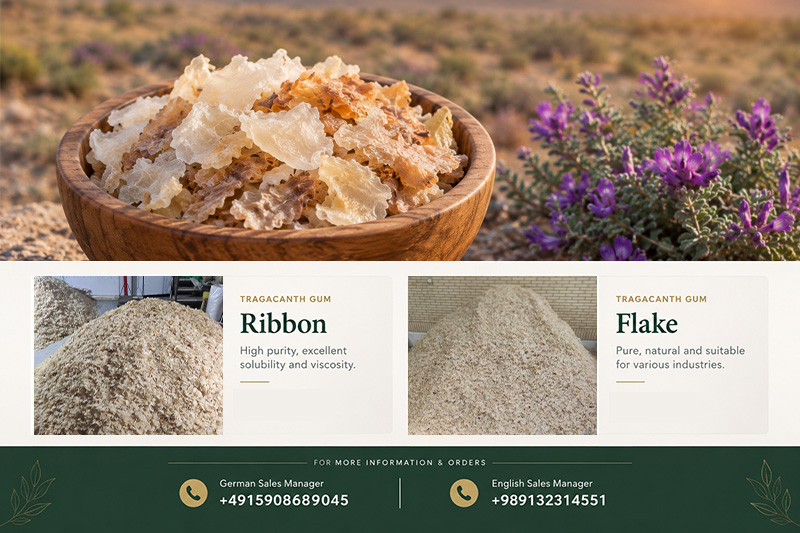
Unground Tragacanth Gum can occur as flattened or layered fragments, curved pieces, ribbons, or twisted strands. Reference specifications describe colors ranging from white to pale yellow, with some pieces potentially showing a reddish tint. Appearance alone, however, cannot establish the complete quality or suitability of a commercial lot.
For bulk purchasing, the buyer should clarify the requested commercial form and determine whether the supplier’s product matches the intended handling, processing, and formulation requirements. If visual appearance is an acceptance criterion, it should be defined clearly before the order is confirmed.
Hydration and viscosity
One of the most important functional characteristics of Tragacanth Gum is its response to water. It can swell and develop highly viscous dispersions or semi-gel systems. The result depends on factors such as the grade, physical form, concentration, preparation procedure, and test conditions.
This means that a statement such as “high viscosity” is not sufficient for a technically controlled purchase. Buyers should specify the relevant test method and operating conditions if viscosity performance is essential to their application.
For example, two products may both be identified as Tragacanth Gum while producing different results under a particular mixing procedure. A comparison is meaningful only when the products are evaluated under sufficiently comparable conditions.
Why Product Specifications Matter to German Buyers
German importers often need to coordinate purchasing decisions with quality assurance, technical teams, regulatory specialists, and logistics providers. A clearly defined product specification helps these teams evaluate the same material against consistent requirements.
Rather than relying on broad descriptions, buyers should identify the parameters that matter to the intended application. Depending on the product and its use, these may include botanical identity, physical form, appearance, moisture-related information, relevant analytical results, microbiological criteria, contaminant testing, and functional performance.
Not every parameter is mandatory for every purchase. The applicable specification should be established according to the intended use, relevant legislation, contractual requirements, and the buyer’s quality system.
| Evaluation Area |
Why It Matters |
Recommended Buyer Action |
| Product identity |
Confirms that the material corresponds to the requested product |
Request the product description and relevant identification information |
| Commercial form |
Affects handling, preparation, inspection, and processing |
Specify the required form and acceptable physical characteristics |
| Functional performance |
Helps establish suitability for the intended formulation |
Define relevant test methods and performance criteria |
| Quality documentation |
Supports purchasing decisions and quality assurance |
Request available specifications and applicable batch documentation |
| Regulatory suitability |
Requirements depend on the product category and intended use |
Confirm applicable EU and German requirements before ordering |
| Packaging and traceability |
Supports handling, identification, and shipment planning |
Agree on packaging details, lot identification, and transport conditions |
Understanding E 413 and Its Regulatory Context
Tragacanth Gum is identified as E 413 when considered as the corresponding food additive under applicable European Union legislation. This designation is relevant to food-related purchasing, but it should not be interpreted as blanket approval for every product, application, or commercial grade.
EU food additive rules specify the permitted uses and conditions for authorised additives. The applicable provisions must be checked against the current legislation and the precise food category and use under consideration.
Consequently, buyers planning to use Tragacanth Gum in food manufacturing should verify that the material meets the applicable identity and purity specifications and that its intended use complies with the relevant authorisation conditions. Other intended uses may involve different legal frameworks and documentation requirements.
The European Commission provides information on food additive authorisation and applicable EU rules. The consolidated legislation should be checked at the time of the transaction because regulatory requirements can change.
European Commission: Food Additives and EU Requirements
Important regulatory distinction
Identifying a substance as E 413 does not establish that a particular commercial lot is compliant, certified, or suitable for a specific application. Product specifications, intended use, applicable legislation, and supporting documentation must be evaluated separately.
First Steps Before Requesting a Quotation
A structured inquiry helps an exporter understand the buyer’s actual needs and determine which product information must be confirmed. Before requesting a commercial offer, prepare the following details wherever possible:
- Intended application: Explain how the material will be used and whether the application is food-related, pharmaceutical, cosmetic, or industrial.
- Required product form: State whether you are seeking stick-type, granular or cluster-type, or another specifically defined form.
- Technical requirements: Provide relevant specifications, testing methods, and acceptance criteria.
- Order quantity: Specify the quantity required for the initial order and any anticipated recurring demand.
- Documentation: Identify the technical, analytical, traceability, and regulatory documents required by your organisation.
- Packaging: Describe any requirements concerning pack size, material, labeling, palletisation, and handling.
- Delivery destination: Confirm the delivery location in Germany or elsewhere and the preferred delivery terms.
- Timing: Provide the desired shipment window so that availability and logistics can be discussed without assuming an unconfirmed delivery commitment.
Pars Ketira can be contacted to discuss product requirements and request information about available forms. Specific stock, grade availability, technical parameters, order quantities, documentation, and delivery arrangements should be confirmed directly before a purchase commitment is made.
For German buyers, the German Sales Manager is the primary contact for inquiries about product suitability, specifications, and export arrangements. International buyers communicating in English should contact the English Sales Manager.
2. Commercial Forms and Grade Selection of Tragacanth Gum
Tragacanth Gum is traded in different physical forms, and selecting the appropriate form is an important step for German importers. The shape, color, thickness, degree of cleaning, and processing history can influence how the material is inspected, handled, prepared, and used.
Two widely described traditional commercial forms are ribbon-type gum and flake-type gum. In Iranian commercial terminology, these forms are commonly associated with Tragacanth Gum Maftuli and Tragacanth Gum Kharmani, respectively. However, commercial naming conventions may vary between suppliers, and buyers should confirm the precise physical form being offered.
Pars Ketira offers stick-type and granular or cluster-type Tragacanth Gum, subject to actual product availability. Buyers should request a current product description and, where appropriate, a representative sample before confirming that a commercial designation matches their technical requirements.
2.1. Stick-Type Tragacanth Gum
Ribbon-type Tragacanth Gum generally appears as elongated, flattened, curved, or twisted pieces. The material can vary in color and dimensions according to its botanical source, collection conditions, and commercial grade.
In technical literature, ribbon-type gum is often associated with relatively high viscosity compared with flake-type material. Nevertheless, the physical form alone does not guarantee a specific viscosity or establish compliance with a buyer's technical specification.
For procurement purposes, German buyers should confirm the actual appearance, dimensions, cleanliness, and relevant functional properties of the offered material. If the gum will subsequently be milled, dissolved, or incorporated into a formulation, its performance should be assessed under the intended processing conditions.
Stick-type gum may be appropriate for buyers who specifically require recognizable elongated pieces for inspection, sorting, or further processing. Its suitability depends on the application and the agreed product specification rather than on the commercial name alone.
2.2. Granular, Cluster-Type, and Flake-Type Tragacanth Gum
Flake-type Tragacanth Gum typically consists of shorter, broader, or irregular pieces rather than elongated ribbons. Depending on the source material and sorting process, buyers may encounter descriptions such as flakes, clusters, or granular pieces.
These terms should not automatically be treated as interchangeable. A cluster-type product offered by a supplier may have a particular appearance or grading definition that differs from another supplier's flake-type material. Before purchasing, request a product description that clearly identifies the physical form and any applicable grade designation.
Technical publications indicate that ribbon and flake forms can differ in their functional behavior. Ribbon-type material is often associated with higher viscosity, while flake-type material may exhibit different surface activity. The actual result depends on the gum's characteristics and the conditions under which it is tested.
Consequently, buyers should not select a product solely because it is described as a higher grade or a more economical form. The correct choice is the material that satisfies the requirements of the intended application and the agreed acceptance criteria.
2.3. Comparison of Commercial Forms
| Comparison Factor |
Stick or Ribbon Type |
Flake or Cluster Type |
What Buyers Should Confirm |
| General appearance |
Elongated, flattened, curved, or twisted pieces |
Shorter, broader, or irregular pieces |
Representative appearance and acceptable dimensions |
| Functional behavior |
Often associated with higher viscosity |
May exhibit different viscosity and surface activity |
Measured performance under agreed test conditions |
| Inspection |
Assess piece shape, color, cleanliness, and consistency |
Assess flake shape, color, cleanliness, and consistency |
Written visual acceptance criteria |
| Processing requirements |
May require size reduction or further preparation |
May require size reduction or further preparation |
Equipment, hydration procedure, and target performance |
| Commercial specification |
Must be clearly identified in the quotation and order |
Must be clearly identified in the quotation and order |
Exact product description and agreed grade |
Buyer recommendation: Include the requested physical form in the purchase specification and commercial invoice description where appropriate. Do not rely exclusively on a translated product name if the shape, grade, or processing requirements are important to acceptance.
2.4. Whole Gum Versus Powdered Tragacanth Gum
Tragacanth Gum may also be supplied in a powdered form when suitable processing has been carried out. Whole gum and powdered gum can behave differently during preparation because particle size and dispersion influence hydration.
Powdering can make the material easier to incorporate into some manufacturing processes, but finer particles can also form aggregates if they are not dispersed correctly. Buyers should therefore consider both the desired particle size and the mixing procedure used in their facility.
Powdered material should not be assumed to be superior to whole gum in every situation. The appropriate choice depends on equipment, preparation time, functional targets, storage arrangements, and the intended use.
Before ordering powdered Tragacanth Gum, confirm the following details where relevant:
- Target particle-size distribution and the applicable measurement method.
- Appearance and acceptable color range.
- Moisture-related specification and analytical method.
- Relevant viscosity or hydration-performance requirements.
- Foreign-matter controls and applicable purity criteria.
- Packaging that protects the material during storage and transport.
- Required analytical and batch documentation.
These are specification points to discuss, not claims that every product offered by Pars Ketira is available in powdered form or meets any particular numerical value.
2.5. How to Select a Grade for Your Application
The word “grade” can refer to different things in commercial transactions. It may describe physical form, visual quality, a supplier's internal classification, a set of analytical characteristics, or compliance with a defined standard.
For this reason, a grade name should be supported by a clear written specification. If two suppliers use different grading systems, their products cannot be compared reliably based on the grade labels alone.
German importers should define the essential characteristics first and then ask each supplier to confirm how the offered product meets them.
| Buyer Requirement |
Specification to Discuss |
Evidence to Request |
| Consistent physical appearance |
Form, color, dimensions, and acceptable variation |
Representative sample and written description |
| Defined thickening performance |
Viscosity target, concentration, temperature, and test method |
Relevant technical data or laboratory results, where available |
| Controlled particle size |
Particle-size range and permitted variation |
Particle-size test results, where applicable |
| Food-related use |
Applicable food-additive identity, purity, and use requirements |
Relevant specification and supporting compliance documentation |
| Industrial processing |
Performance parameters specific to the manufacturing process |
Technical data and, if appropriate, a controlled application test |
2.6. Sample Evaluation Before Bulk Purchasing
Where a representative sample is available, evaluating it before a larger purchase can help reduce uncertainty. The evaluation should follow the buyer's actual acceptance criteria rather than an informal visual inspection alone.
A practical evaluation process may include:
- Confirm product identity: Check that the sample description matches the product specified in the inquiry.
- Inspect physical characteristics: Examine color, shape, visible foreign matter, and consistency with the agreed description.
- Review documentation: Compare available technical information with the buyer's written requirements.
- Conduct application testing: If functionality is important, test the sample using a documented procedure representative of the intended process.
- Record the results: Document the sample identification, test conditions, observations, and acceptance decision.
- Agree on the production-lot requirements: Clarify which specifications and documents must apply to the delivered shipment.
A sample evaluation does not automatically establish that every subsequent shipment will have identical characteristics. Buyers should agree on lot identification, applicable specifications, inspection procedures, and how any material deviation will be handled commercially.
Looking for a Tragacanth Gum Supplier for Germany?
Discuss your required product form, technical specifications, documentation, and purchasing needs with the German Sales Manager before confirming an order.

2.7. Common Mistakes When Comparing Commercial Forms
Several avoidable purchasing errors can occur when buyers compare Tragacanth Gum offers from different suppliers.
- Comparing names instead of specifications: Similar product names may describe different physical forms or grading systems.
- Assuming that color proves quality: Color is one inspection characteristic, not a complete assessment of identity, purity, or performance.
- Assuming that all ribbon-type gum has the same viscosity: Functional performance varies by grade and test conditions.
- Confusing raw gum with processed powder: Processing and particle size can change handling and hydration behavior.
- Ignoring intended use: A material suitable for one application may not satisfy the technical or legal requirements of another.
- Ordering bulk quantities without defining acceptance criteria: Ambiguous specifications can lead to disagreements over whether the delivered material meets the contract.
The most reliable purchasing approach is to define the product in measurable or clearly observable terms, obtain supporting information, and confirm the agreed specification before the order is finalized.
2.8. Practical Checklist for German Importers
Use the following checklist when preparing an inquiry for Pars Ketira or another Tragacanth Gum supplier:
- Identify the intended application and relevant regulatory category.
- Specify stick, ribbon, flake, cluster, or powder form as applicable.
- Request clarification of any supplier-specific grade name.
- Define the technical characteristics that determine product acceptance.
- Ask which specifications and analytical documents are available for the offered product.
- Determine whether a representative sample can be provided and under what commercial conditions.
- Agree on packaging, lot identification, and inspection arrangements.
- Confirm quantity, destination, delivery terms, and quotation validity directly with the supplier.
For general technical background on the differences between ribbon and flake Tragacanth Gum, see the following references:
3. Tragacanth Gum Applications: Selecting the Right Product for Each Industry
Tragacanth Gum is a natural hydrocolloid with functional properties that can make it useful in selected food, pharmaceutical, cosmetic, and industrial formulations. Its commercial value depends on how effectively the material meets the technical requirements of a particular manufacturing process.
For German importers, distributors, and industrial purchasing teams, identifying the intended application is one of the most important steps in selecting a suitable product. A material that performs well as a thickener in one formulation may not deliver the required stability, texture, or processing behavior in another.
Product suitability also involves more than functionality. Buyers must consider the applicable legal framework, relevant quality specifications, available analytical documentation, and any restrictions associated with the intended end use.
3.1. Food Industry Applications
Tragacanth Gum has a history of use in selected food formulations because of its ability to increase viscosity and contribute to the stability of certain dispersed systems. Depending on the formulation and processing conditions, it may be considered for products where thickening, suspension, or texture modification is required.
However, its suitability cannot be assumed for every food product. The required performance depends on the formulation, concentration, processing conditions, and interaction with other ingredients.
Thickening and texture modification
Food manufacturers may evaluate Tragacanth Gum when they need to adjust the consistency of a formulation. The gum's water interaction and viscosity characteristics can be useful in selected applications, but the final effect must be established through controlled formulation testing.
For example, a manufacturer developing a viscous food preparation should assess how the ingredient performs at the intended concentration and under the actual mixing, heating, cooling, and storage conditions. The material's suitability should be determined from the resulting product rather than from a general claim about thickening ability.
Stabilization of dispersed systems
Some food formulations contain ingredients that must remain distributed throughout the product. Hydrocolloids may help modify the continuous phase and influence the behavior of such systems. Tragacanth Gum may be evaluated for this purpose where its characteristics are appropriate.
Nevertheless, stability depends on the complete formulation. Ingredient composition, particle characteristics, processing methods, and storage conditions can all influence the result. Laboratory trials are therefore important before a manufacturer commits to large-scale production.
Food-grade requirements for the German market
When Tragacanth Gum is intended for food use in Germany, the buyer should confirm the applicable European Union food additive requirements. Tragacanth is identified as E 413 in the relevant EU framework, but the designation does not automatically establish that every commercial lot is suitable for every food application.
Purchasers should verify the applicable identity and purity criteria, authorised uses and conditions, and the documentation required by their quality assurance system. Where relevant, they should also establish requirements for contaminants, microbiological quality, traceability, and batch-specific analytical information.
Do not assume that a product described as natural, raw, or food-grade is automatically compliant with all applicable German and EU requirements. Compliance must be supported by appropriate evidence for the particular product and intended use.
3.2. Pharmaceutical and Nutraceutical Applications
Tragacanth Gum has historically been used in certain pharmaceutical formulations because of its thickening and colloidal properties. Depending on the formulation, it may be investigated as an excipient or as a functional ingredient that contributes to the physical characteristics of a preparation.
Potential pharmaceutical applications require particularly careful evaluation. A material suitable for a general industrial application cannot automatically be used in a medicinal product, and a food-related specification does not by itself establish pharmaceutical suitability.
Formulation and excipient considerations
Pharmaceutical developers may assess a gum's performance in relation to viscosity, dispersion behavior, compatibility with other ingredients, and the stability of the final formulation. The relevant requirements depend on the dosage form, manufacturing process, intended route of administration, and applicable quality framework.
Before selecting Tragacanth Gum for a pharmaceutical formulation, the purchasing and technical teams should determine whether the material meets the applicable excipient specifications and whether the supplier can provide the necessary supporting documentation.
Documentation for pharmaceutical buyers
Depending on the intended application and the buyer's quality system, relevant documentation may include:
- A clearly defined product specification and material identification.
- Available batch-specific certificates of analysis.
- Relevant purity and contaminant information.
- Traceability information and lot identification.
- Information about applicable compendial requirements, where relevant.
- Additional quality or regulatory documents required for the intended use.
These documents should be requested and evaluated rather than presumed to be available. Buyers should also establish whether the proposed material is appropriate for the intended medicinal or pharmaceutical application before placing an order.
Nutraceutical products
Nutraceutical and dietary supplement manufacturers should assess Tragacanth Gum according to the product category, intended function, and relevant legal requirements. Requirements can differ depending on whether the material is used as a technological ingredient, an excipient, or another component of the finished product.
For German buyers, the product classification and applicable regulatory framework should be confirmed before sourcing. The supplier's product description alone is not a substitute for a regulatory assessment by the responsible business or its qualified adviser.
3.3. Cosmetic and Personal Care Formulations
Cosmetic manufacturers may investigate Tragacanth Gum when developing formulations that require viscosity adjustment, texture modification, or stabilization. Its usefulness depends on the desired product characteristics and its compatibility with the formulation's other components.
Possible development areas include selected creams, lotions, gels, and other personal care preparations. These are potential application categories, not a guarantee that a particular commercial grade is suitable for each product.
Texture and consistency
In cosmetic development, the texture of a formulation can influence application, dispensing, and consumer experience. A hydrocolloid may help modify the consistency of a water-based system, but the result depends on concentration, preparation procedure, pH, other ingredients, and the overall formulation design.
Formulators should test the material under representative production conditions. They should also evaluate whether the resulting texture remains acceptable during storage and whether the ingredient interacts with other components in an undesirable way.

Compatibility and stability testing
A preliminary formulation test should establish whether the gum disperses adequately and delivers the desired performance. Where relevant, further testing may examine changes in viscosity, appearance, odor, and physical stability over time.
The testing programme should reflect the finished product and its intended use. No single test can establish suitability for every cosmetic formulation.
Regulatory considerations
For cosmetic products placed on the EU market, the responsible business must determine the applicable requirements under the EU Cosmetics Regulation and other relevant provisions. Ingredient suitability, safety assessment, product documentation, and the responsibilities of the relevant economic operators should be evaluated as part of the wider compliance process.
Buyers should not assume that food-grade status, natural origin, or a supplier's general product description is sufficient to establish compliance with cosmetic requirements.
3.4. Industrial Applications
Outside food, pharmaceutical, and cosmetic manufacturing, Tragacanth Gum may be investigated for selected applications that benefit from its thickening or colloidal behavior. Suitability depends on the technical demands of the process and whether the gum can provide the required performance under actual operating conditions.
Water-based formulations
Manufacturers working with water-based systems may consider Tragacanth Gum when viscosity or dispersion characteristics are important. However, its use should be evaluated against the requirements of the particular formulation, including compatibility with other ingredients and the conditions under which the product will be processed or stored.
Specialty manufacturing
Some specialty industrial formulations require natural materials with specific handling or rheological characteristics. In such cases, Tragacanth Gum may be considered during material selection or formulation development.
Its suitability should be demonstrated through application-specific testing. Buyers should not assume that the gum is interchangeable with guar gum, xanthan gum, gum arabic, or other hydrocolloids, because these materials have different compositions and functional characteristics.
Technical evaluation before industrial purchasing
Industrial buyers should define the performance requirements that matter to their production process. Depending on the application, these may include:
- Required viscosity or flow behavior under specified conditions.
- Dispersion and hydration characteristics.
- Compatibility with other formulation components.
- Performance during processing and storage.
- Acceptable appearance and physical consistency.
- Packaging and handling requirements.
- Batch consistency and relevant quality documentation.
These criteria should be adapted to the actual process. A general-purpose specification may not provide enough information for a technically demanding industrial application.
3.5. Application Suitability Comparison
The following table provides a preliminary framework for evaluating potential uses. It is intended to guide purchasing discussions rather than certify that a specific product is suitable for a particular industry.
| Industry |
Potential Functional Objective |
Key Evaluation Criteria |
Important Qualification |
| Food manufacturing |
Thickening, texture modification, or stabilization |
Functional performance, identity, purity, and relevant analytical data |
Verify authorised uses and applicable EU food requirements |
| Pharmaceutical manufacturing |
Selected excipient or formulation functions |
Applicable specifications, quality documentation, and formulation compatibility |
Confirm suitability for the specific pharmaceutical use |
| Nutraceutical products |
A formulation-dependent technological or excipient function |
Product classification, intended use, and quality requirements |
Assess the applicable legal framework and intended product category |
| Cosmetics and personal care |
Viscosity adjustment and texture modification |
Compatibility, stability, functional performance, and ingredient documentation |
Evaluate compliance with relevant EU cosmetic requirements |
| Industrial formulations |
Selected thickening or colloidal functions |
Process conditions, flow behavior, compatibility, and cost-performance balance |
Validate performance in the intended production system |
3.6. How to Match Tragacanth Gum to a Manufacturing Process
A systematic selection process helps prevent buyers from choosing a product based on its name or general reputation rather than its actual performance.
- Define the end use. Explain what the material must do in the finished product or manufacturing process.
- Identify the relevant legal category. Determine whether the intended application triggers food, pharmaceutical, cosmetic, or other specific requirements.
- Set the technical criteria. Establish the required physical characteristics, functional performance, and quality parameters.
- Request product information. Ask the supplier for the available specification, relevant analytical documentation, and a clear description of the commercial form.
- Evaluate the material. Conduct suitable laboratory or application tests where necessary.
- Agree on acceptance requirements. Document the specifications and quality conditions that will apply to the purchase.
- Review the commercial offer. Compare product suitability alongside price, packaging, quantity, documentation, delivery terms, and other transaction costs.
This approach is particularly valuable for German importers buying for regulated or technically demanding applications. It creates a clearer connection between the material being purchased and the requirements of the business that will use it.
3.7. Questions to Ask Before Selecting an Application-Specific Grade
Before placing an order, procurement teams should be able to answer several practical questions:
- What role will Tragacanth Gum perform in the formulation?
- Which physical form is most suitable for the manufacturing process?
- Which functional parameters must be measured?
- Are there mandatory identity, purity, or safety requirements?
- Which analytical documents can the supplier provide?
- Is a representative sample available for evaluation, subject to supplier confirmation?
- What packaging and handling arrangements are appropriate?
- What evidence will be required to accept the delivered shipment?
Answering these questions helps buyers distinguish between a product that is merely described as Tragacanth Gum and a product that has been evaluated against their actual purchasing requirements.
3.8. Practical Recommendation for German Importers
For businesses sourcing Tragacanth Gum for Germany, the recommended starting point is a written product brief that describes the application, required physical form, technical criteria, documentation needs, and anticipated order quantity.
Food manufacturers should confirm the relevant EU food additive requirements. Pharmaceutical buyers should establish the applicable material and quality specifications for the intended use. Cosmetic businesses should evaluate formulation performance and the relevant EU compliance obligations. Industrial manufacturers should focus on process-specific functionality and compatibility.
These distinctions make supplier discussions more productive and help prevent inappropriate comparisons between products intended for different purposes.
Pars Ketira can be contacted to discuss the available Tragacanth Gum forms and the information relevant to a prospective order. Specific application suitability, technical parameters, documentation, and commercial availability must be confirmed for the product under consideration.
4. How to Evaluate a Tragacanth Gum Supplier
Selecting a reliable Tragacanth Gum supplier is an important step for German importers, food ingredient distributors, pharmaceutical raw-material buyers, cosmetic manufacturers, and other industrial purchasers. A competitive quotation is only one part of a sound purchasing decision. Buyers should also evaluate product consistency, traceability, documentation, communication, packaging suitability, and the supplier’s ability to understand the requirements of the intended application.
For businesses sourcing Tragacanth Gum internationally, the objective is to establish a transparent purchasing relationship in which both parties understand the product being offered, the quality criteria that must be met, the documents required, and the commercial terms governing the transaction.
Pars Ketira supplies Tragacanth Gum for domestic and international business inquiries. Buyers can use the evaluation framework below to define their requirements and discuss available products, specifications, and export arrangements before placing a commercial order.
4.1. Start With a Clearly Defined Purchasing Requirement
Before approaching suppliers, prepare a concise description of the material you need. The term “Tragacanth Gum” alone may not provide enough information for a supplier to identify the most suitable commercial product. Requirements can differ according to the intended application, physical form, processing requirements, and internal quality standards.
A useful initial purchasing brief should cover the following points:
- Intended application: Explain whether the gum is being considered for food, pharmaceutical, cosmetic, laboratory, or industrial use.
- Required commercial form: Specify whether you are seeking stick-type, ribbon-like, granular, clustered, flaked, or powdered material.
- Quality expectations: Identify the characteristics that matter to your process, such as appearance, foreign-matter limits, moisture, solubility or hydration behavior, and other application-specific properties.
- Regulatory requirements: State any relevant European Union requirements, customer specifications, or internal quality standards that the material must satisfy.
- Quantity: Provide the estimated initial order volume and, where relevant, anticipated repeat purchasing requirements.
- Packaging preferences: Describe the preferred package format, net weight, labeling requirements, and any moisture-protection expectations.
- Destination and delivery terms: Identify the delivery location in Germany and the proposed Incoterm or ask the supplier to quote suitable alternatives.
- Required documents: List the technical, quality, commercial, and shipment documents your company needs before approval or import.
Clear requirements make supplier quotations easier to compare. They also reduce the risk of receiving offers for different product forms or quality levels that appear similar in price but are not equivalent for the intended application.
4.2. Assess Product Identification and Traceability
A supplier should be able to identify the product being quoted with enough detail to distinguish it from other commercial forms or grades. Buyers should avoid relying on a generic product name when preparing a purchase order, approving a sample, or setting up a new raw material in their quality management system.
Ask the supplier to confirm the product description and the information used to identify each supplied lot. Depending on the product and transaction, relevant details may include:
- Commercial product name and physical form.
- Grade or specification reference, if a defined grading system is used.
- Lot or batch identification, where applicable.
- Country of origin and supporting origin documentation where required.
- Applicable product specification and revision date.
- Available batch-specific quality records.
- Packaging identification and net quantity.
Traceability is especially important when the imported material will be incorporated into a finished product. If a quality issue arises, clear lot identification helps the buyer connect the affected material with the relevant purchase order, shipment, inspection record, and production batch.
Do not assume that every supplier uses the same grading terminology or that similarly named grades have identical properties. Ask for written definitions and compare the actual specifications rather than relying on grade names alone.
4.3. Review the Technical Specification Before Comparing Prices
A technical specification should describe the characteristics that define acceptable material for the buyer’s intended use. Its detail will depend on the application and the level of control required by the purchasing company. A brief product description may be sufficient for an initial inquiry, but it is generally not a substitute for an agreed specification when a commercial order depends on measurable quality criteria.
When reviewing a supplier’s specification, consider whether it identifies:
- Product identity and commercial form.
- Relevant physical and appearance characteristics.
- Moisture or other measurable parameters where applicable.
- Foreign-matter and cleanliness criteria.
- Test methods or analytical methods, when necessary for consistent evaluation.
- Acceptance limits and units of measurement.
- Applicable food-grade, pharmacopoeial, cosmetic, or other requirements, where relevant and substantiated.
- Storage conditions and any handling precautions specified for the product.
Not every parameter is relevant to every application, and not every commercial product will have the same set of test results. Buyers should identify which characteristics are essential to their own process and ask the supplier to clarify any missing information before approving the material.
For regulated applications, technical review should be coordinated with the buyer’s quality or regulatory team. A supplier’s general statement that a material is “natural,” “pure,” or “high quality” should not replace the documentation and evidence required for the specific intended use.
4.4. Evaluate Samples Using a Repeatable Procedure
A sample can help determine whether a particular Tragacanth Gum product is suitable for a buyer’s application. However, a sample assessment is most useful when the buyer defines the evaluation criteria in advance and records the results consistently.
Begin by confirming that the sample represents the commercial product being offered. Ask for its product description and, where available, lot identification and associated technical information. If the sample is supplied under a particular grade or specification, record that reference so it can be compared with the eventual shipment.
A structured sample evaluation may include the following stages:
- Visual inspection: Examine the appearance, physical form, and visible presence of foreign material against the buyer’s documented criteria.
- Identity review: Check whether the sample matches the product description and any agreed reference sample.
- Application testing: Test the material under controlled conditions relevant to the intended process, using appropriate equipment and procedures.
- Documentation review: Compare the sample information with the supplier’s specification and any quality documents provided.
- Acceptance decision: Record whether the sample is accepted, rejected, or requires clarification or further testing.
- Reference retention: Where practical, retain an identified reference sample according to the buyer’s internal procedures.
For functional testing, avoid making a purchasing decision based only on a general observation such as how quickly the material appears to hydrate. Results may depend on particle size, preparation method, water quality, temperature, mixing conditions, concentration, and the specific application. Tests should therefore use a documented method that can be repeated when a new shipment arrives.
Approval of a sample should not automatically be treated as proof that every future batch will be identical. Before ordering, agree on the specification and acceptance criteria that will apply to the commercial material.
4.5. Examine the Supplier’s Quality Documentation
Documentation requirements depend on the buyer’s industry, the product’s intended use, and the applicable legal framework. A responsible purchasing process distinguishes between documents that are available, documents that are required for the particular transaction, and documents that must be verified by the buyer’s quality or regulatory team.
Depending on the transaction, ask which of the following documents can be provided and whether they apply to the exact product being quoted:
- Product specification: A written description of the product and its relevant acceptance criteria.
- Certificate of Analysis (CoA): A report of analytical results for a specified batch, when available and applicable.
- Safety Data Sheet (SDS): Documentation where required or appropriate for the material and supply context.
- Origin information: Information supporting the declared country of origin, with formal proof where required.
- Regulatory statements: Statements relevant to the buyer’s intended use, provided they are applicable and supported.
- Packaging details: Information about packaging material, net weight, labeling, and handling.
- Commercial and shipping documents: Documents required for the agreed sale, transport, customs clearance, and delivery.
Do not assume that a document is available merely because it appears on this list. Confirm availability, scope, issuing party, and timing with the supplier. Similarly, do not assume that a generic document applies to every batch or proves compliance with every requirement in Germany or the European Union.
Where a certificate or statement is important to regulatory acceptance, the buyer should verify its relevance with the appropriate internal specialist or competent authority. The product name, legal entity, batch reference, and declared scope should be consistent wherever applicable.
4.6. Check Communication, Commercial Transparency, and Responsiveness
Effective communication is a practical part of supplier qualification. Buyers need clear answers about the product, the quotation, the documentation, and the conditions under which an order can be accepted and delivered. During the inquiry stage, evaluate whether the supplier responds directly to the questions asked and identifies matters that still need confirmation.
Useful indicators of transparent communication include:
- Clear identification of the offered product and its commercial form.
- Written confirmation of the specification or quality criteria being quoted.
- Explicit distinction between confirmed information and details still subject to verification.
- Itemized quotation information, including quantity, packaging, currency, and delivery terms.
- Clear explanation of which documents are available and when they can be supplied.
- A defined process for confirming an order and communicating shipment updates.
- Willingness to address reasonable technical and commercial questions before commitment.
Responsiveness alone does not prove product quality, and a polished presentation does not establish regulatory compliance. Use communication as one part of a broader assessment that includes technical evidence, commercial documentation, and any due diligence required by your organization.
4.7. Compare Quotations on an Equivalent Basis
Price comparisons can be misleading when suppliers quote different product forms, packaging formats, specifications, or delivery conditions. Before selecting an offer, normalize the main commercial variables so the quotations describe comparable transactions.
| Comparison factor |
Questions to ask |
Why it matters |
| Product identity |
Are the form, grade, and specification equivalent? |
Different products may not be interchangeable. |
| Quality evidence |
Are the required test results and documents included or available separately? |
The evidence available may affect approval and inspection requirements. |
| Quantity and packaging |
Is the price based on the same net quantity and comparable packaging? |
Package configuration can affect handling and total cost. |
| Delivery terms |
Are the Incoterm, named place, and cost responsibilities clearly stated? |
Different delivery terms allocate costs and responsibilities differently. |
| Lead time |
Is the timing confirmed, and what events could affect it? |
Planning depends on realistic and clearly communicated delivery expectations. |
| Payment terms |
Are the currency, payment schedule, and applicable charges explicit? |
Payment conditions affect cash flow and transaction risk. |
| Claims and acceptance |
How are discrepancies, damaged packages, or specification failures handled? |
A documented process reduces uncertainty if problems occur. |
When necessary, ask each supplier to revise its quotation against the same written purchasing brief. A higher quotation may include different packaging, documentation, or delivery responsibilities; a lower quotation may exclude costs that the buyer will need to arrange separately. The decision should be based on the full commercial comparison rather than the headline price alone.
4.8. Review Export Experience Without Relying on Unsupported Claims
For an import transaction into Germany, buyers should establish whether the supplier understands the practical requirements of the proposed shipment. Rather than relying solely on broad statements about export experience, ask specific questions about the transaction you intend to conduct.
Questions may include:
- Can the supplier identify the proposed product and confirm the details that will appear on the quotation and commercial documents?
- Which export and shipping documents can be provided for the specific transaction?
- Can the supplier confirm the proposed packaging configuration and shipment quantity?
- Which delivery terms can be quoted, and what responsibilities will remain with the buyer?
- What information must the buyer provide before the order and shipment can be finalized?
- Can the supplier coordinate document details with the buyer or the buyer’s appointed logistics provider?
These questions help establish whether the supplier can support the proposed transaction without assuming that a particular certification, shipping route, delivery time, or customs outcome is guaranteed. The buyer should independently confirm import eligibility, customs requirements, and any sector-specific obligations that apply to the intended use.
4.9. Identify Warning Signs During Supplier Qualification
Supplier qualification should also identify gaps that need to be resolved before a purchase commitment. A warning sign does not automatically prove misconduct, but it should prompt further questions and, where appropriate, additional verification.
| Potential warning sign |
Recommended buyer response |
| The supplier cannot clearly identify the offered product. |
Request a precise product description and written specification before comparing the offer. |
| Important quality claims are not supported by documents. |
Ask for relevant evidence and have it reviewed before approving the material. |
| The sample and quoted commercial product appear to be described differently. |
Clarify the product identity and ensure the approved sample is linked to the purchase specification. |
| The quotation omits delivery terms, packaging, or payment conditions. |
Request a complete written quotation before committing funds. |
| The supplier guarantees regulatory acceptance without establishing the product’s intended use and applicable requirements. |
Seek specific supporting documentation and confirm requirements independently. |
| The supplier pressures the buyer to proceed before material questions are answered. |
Pause the decision until product, documentation, payment, and delivery details are sufficiently clear. |
4.10. Use a Structured Supplier Evaluation Matrix
A simple scoring matrix can help procurement teams compare shortlisted suppliers consistently. Assign each supplier a score against the same criteria and record the evidence supporting each score. The weights below are illustrative and should be adjusted to reflect the buyer’s industry, risk tolerance, and internal purchasing procedures.
| Evaluation criterion |
Illustrative weight |
Evidence to record |
| Product suitability |
25% |
Specification, sample results, application assessment. |
| Quality documentation |
20% |
Applicable certificates, test reports, traceability information. |
| Commercial transparency |
15% |
Complete quotation, payment terms, exclusions, and conditions. |
| Export and logistics coordination |
15% |
Document planning, packaging details, and agreed delivery responsibilities. |
| Communication and responsiveness |
10% |
Accuracy, clarity, and timely responses to material questions. |
| Price and total purchasing cost |
15% |
Comparable pricing, freight allocation, packaging, and other applicable costs. |
Important: A weighted score should not override a mandatory requirement. If a product fails an essential quality criterion or cannot meet a legal requirement applicable to its intended use, a high score in other categories does not make it acceptable. Treat critical compliance and quality requirements as pass-or-fail gates before using the scoring matrix to rank commercially suitable suppliers.
4.11. Prepare a Request for Quotation (RFQ)
A well-structured request for quotation helps the supplier provide a relevant offer and gives the buyer a consistent basis for comparison. The following template can be adapted for a German import inquiry.
Subject: Request for Quotation – Tragacanth Gum for Delivery to Germany
Dear Sales Team,
We are evaluating suppliers of Tragacanth Gum for a potential purchase and would appreciate a quotation based on the requirements below.
- Intended application: [Specify application]
- Required product form or grade: [Specify requirements]
- Required specification: [Attach specification or list essential parameters]
- Estimated quantity: [Specify quantity and unit]
- Packaging preference: [Specify package type, net weight, and labeling needs]
- Delivery destination: [City and postal code, Germany]
- Preferred delivery terms: [Specify Incoterm and named place, or request alternatives]
- Required documents: [List applicable technical, quality, origin, and shipping documents]
- Sample requirement: [State whether a sample is required before ordering]
- Expected purchasing schedule: [Specify target timing, subject to confirmation]
Please confirm the product description, available specification, quotation validity, unit price and currency, packaging details, minimum order requirements if applicable, payment terms, estimated preparation and transit arrangements where known, and any costs excluded from the quotation.
Please also indicate which documents can be supplied for the proposed product and shipment, and identify any information you need from us before confirming the offer.
Thank you. We look forward to reviewing your proposal.
Kind regards,
[Name]
[Company]
[Contact details]
4.12. Final Supplier Qualification Checklist
Before placing an order, use the checklist below to confirm that the main evaluation steps have been completed. Some items may not apply to every transaction; the buyer should identify mandatory requirements according to the product’s intended use and the applicable import and industry rules.
- Product identity and commercial form are clearly stated.
- The proposed product matches the intended application.
- The specification and acceptance criteria have been reviewed.
- The sample has been evaluated where required.
- Relevant quality documents have been reviewed for scope and applicability.
- Lot identification and traceability arrangements have been clarified where applicable.
- Packaging and labeling requirements have been discussed.
- The quotation identifies quantity, currency, payment terms, and validity.
- The delivery term and named place are clearly stated.
- Responsibilities for transport, insurance, customs procedures, and related costs have been clarified under the agreed terms.
- The documents required for the specific shipment have been identified.
- Any mandatory regulatory or customer requirements have been verified by the responsible party.
- The process for reporting discrepancies, quality concerns, or shipment damage has been agreed.
- The purchase order reflects the approved product description, specification, quantity, packaging, and commercial terms.
For German buyers, the most effective supplier evaluation process combines product evidence, clear commercial terms, and a realistic understanding of the responsibilities involved in importing the material. A disciplined qualification process does not eliminate every risk, but it makes uncertainties visible before they become costly problems during shipment, customs clearance, or production.
Looking for a Tragacanth Gum Export Supplier for Germany?
Contact our sales team to discuss product specifications, available grades, documentation, and your purchasing requirements.
5. Technical Specifications and Quality Documentation for Tragacanth Gum
Technical specifications and quality documentation are central to purchasing Tragacanth Gum for the German market. They help buyers define the material they require, assess whether a product is suitable for its intended application, compare supplier offers, and establish consistent acceptance criteria for incoming shipments.
For importers, distributors, manufacturers, and industrial users, the objective is not simply to obtain a document labelled “quality certificate.” It is to confirm that the documentation identifies the relevant product, describes measurable characteristics, and supports the decisions that must be made before purchase and use.
Requirements can differ significantly depending on whether Tragacanth Gum is intended for food, pharmaceutical, cosmetic, or other industrial applications. Buyers should therefore establish their intended use before deciding which specifications, analytical results, and regulatory documents are necessary.

5.1. What Should a Tragacanth Gum Technical Specification Include?
A technical specification is a written reference describing the product and the criteria used to determine whether it meets the buyer’s requirements. Its contents should be appropriate to the product form and intended application rather than copied from a generic specification for another grade or use.
Depending on the product and the purchasing agreement, a specification may cover the following information:
| Specification element |
Information to confirm |
Purpose for the buyer |
| Product identity |
Product name, material description, and relevant grade or form |
Helps prevent confusion between different commercial products. |
| Physical characteristics |
Appearance, physical form, and other relevant descriptive properties |
Supports visual inspection and product identification. |
| Measurable quality parameters |
Applicable limits, test methods, and units of measurement |
Creates objective criteria for quality assessment. |
| Foreign matter and cleanliness |
Agreed limits and assessment methods, where relevant |
Helps define acceptable material condition. |
| Moisture-related criteria |
Applicable moisture limit and measurement method |
Supports quality control and storage planning. |
| Functional properties |
Relevant hydration, viscosity, or performance criteria if specified |
Helps determine suitability for a defined formulation or process. |
| Storage and handling |
Recommended storage conditions and handling precautions |
Supports suitable warehouse and transport arrangements. |
| Document control |
Specification reference, issue date, and revision where applicable |
Ensures the buyer and supplier are using the same requirements. |
Not every specification needs to include every item listed above. The appropriate parameters depend on the product, the application, applicable requirements, and the buyer’s internal quality system. Any mandatory limits should be agreed and documented rather than inferred from a general product description.
5.2. Understand the Difference Between a Specification and a Certificate of Analysis
A technical specification and a Certificate of Analysis (CoA) serve different purposes. Buyers should understand the distinction before evaluating a supplier’s documentation.
- Technical specification: Defines the product characteristics and acceptance criteria that are expected to apply.
- Certificate of Analysis: Reports analytical results for an identified sample or batch, according to the document’s scope and test methods.
- Product data sheet: May provide general product information, characteristics, and handling guidance. It should not automatically be treated as a batch-specific analytical report.
- Regulatory declaration: States a position regarding a defined regulatory matter. Its value depends on its scope, accuracy, applicability, and supporting evidence.
- Safety Data Sheet: Provides relevant safety and handling information where required or appropriate for the material and supply context.
A CoA should be reviewed to determine whether it identifies the relevant batch, lists the parameters tested, provides results and units, and explains or references the methods used where applicable. Buyers should also establish whether the reported results are based on actual batch testing, another defined sampling process, or a different basis stated by the issuing party.
A document containing general product characteristics is not necessarily evidence that a particular shipment meets every agreed criterion. Similarly, a CoA does not, by itself, establish compliance with every legal requirement applicable to a finished food, medicine, cosmetic, or industrial product.
5.3. Evaluate Purity and Foreign-Matter Criteria
Purity is an important consideration when assessing botanical gums, but buyers should avoid relying on the word “pure” without a defined meaning. The relevant criteria depend on the application, the product specification, and the applicable legal or customer requirements.
When discussing purity with a supplier, clarify which characteristics are covered by the claim. These may include identity, the presence of extraneous material, defined analytical parameters, or other product-specific criteria. Ask for the applicable limits and supporting evidence rather than assuming that a single purity percentage describes every aspect of product quality.
For example, a visual inspection can identify certain visible impurities or inconsistencies, but it cannot establish every chemical, microbiological, or other quality attribute. Where laboratory testing is necessary, the buyer should identify the parameters to be tested and determine whether the analytical method is suitable for the material and intended use.
For food and other regulated applications, the buyer’s quality team should confirm the relevant purity criteria and any contaminant limits that apply to the product and its intended use. Requirements for a raw material should not be confused with requirements that apply to the finished product or the entire manufacturing process.
5.4. Moisture and Storage-Related Quality Parameters
Moisture-related criteria can be important when purchasing and storing Tragacanth Gum. However, an appropriate limit should be based on the relevant product specification and evidence rather than an assumed universal value for all commercial forms.
Buyers should ask the supplier to clarify:
- Whether a moisture specification is defined for the offered product.
- The applicable acceptance limit and unit of measurement.
- The method used to determine the reported result, where testing is performed.
- Whether the reported result relates to a specific batch or a general product description.
- What storage and packaging conditions are recommended to help maintain product condition.
- How the supplier identifies and handles material that does not meet the agreed specification.
Moisture should not be considered in isolation from packaging, warehouse conditions, handling, and the time between dispatch and use. Buyers should establish suitable storage arrangements for the actual product and follow the supplier’s documented handling guidance, alongside any requirements imposed by their own quality procedures.
During incoming inspection, any moisture measurement should use an appropriate method and documented sampling procedure. Results from different methods may not be directly comparable, so the method should be agreed where it affects acceptance decisions.
5.5. Functional Testing for the Intended Application
Tragacanth Gum may be selected for functional characteristics such as thickening, stabilization, or its behavior in a formulation. These properties should be evaluated in relation to the intended process rather than assumed from the material name alone.
For buyers whose applications depend on measurable functional performance, the technical discussion may need to address:
- The specific functional property that must be demonstrated.
- The test procedure, equipment, and preparation conditions.
- The concentration or dosage used during evaluation.
- Relevant temperature, mixing, hydration, or resting conditions.
- The units, acceptance range, and method of reporting results.
- Whether the test result applies to the supplied sample, an identified batch, or another defined material reference.
For example, a viscosity result is meaningful only when the measurement conditions and method are sufficiently clear to support comparison. Differences in preparation, concentration, temperature, and measurement technique can affect results. A number without its test context may therefore be insufficient for deciding whether two materials are equivalent.
Where functional performance is essential, buyers should test the material using a procedure relevant to their own application and agree with the supplier on any additional product-specific test requirements. Supplier data can support initial screening, but it may not replace validation within the buyer’s actual formulation or production process.
5.6. Regulatory Documentation for the German and European Union Market
Importing Tragacanth Gum into Germany requires buyers to consider the intended use of the material and the legal framework applicable to that use. The documents required for a food ingredient may differ from those needed for a cosmetic raw material, a pharmaceutical application, or a non-food industrial formulation.
For food-related uses, buyers should verify the applicable European Union rules concerning food additives, purity criteria, permitted uses, and any other requirements relevant to the specific product and application. Tragacanth Gum is associated with the food additive designation E 413 in the European Union, but that designation alone does not establish that a particular product, grade, or proposed use meets all applicable requirements.
Regulatory review should consider the actual intended use, the applicable legal provisions, and the evidence available for the supplied material. Buyers should consult the current official legislation and the responsible regulatory or quality specialist when determining which requirements apply.
Useful starting points for regulatory verification include:
These resources are starting points rather than a substitute for checking the specific provisions in force at the time of import and use. Buyers should not rely on a supplier’s general statement of compliance where a more specific declaration, test result, or legal assessment is required.
5.7. Match Documents to the Correct Product and Shipment
Document consistency is an important part of supplier and shipment verification. A product specification, analytical report, commercial invoice, packing list, and transport document may serve different purposes, but the relevant details should be consistent wherever they refer to the same transaction.
Before shipment, compare the documents for the following information where applicable:
- Product name and description.
- Grade or commercial form.
- Batch or lot reference, where used.
- Net quantity and packaging configuration.
- Seller and buyer details.
- Country-of-origin information and supporting documentation, where required.
- Invoice and packing-list details.
- Any required declarations or certificates associated with the specific transaction.
If a discrepancy is found, request clarification and corrected documentation before the shipment proceeds where practicable. A mismatch does not necessarily indicate a product defect, but unresolved inconsistencies can complicate internal approval, customs processing, or subsequent traceability.
Buyers should also confirm document requirements with their customs representative, freight forwarder, or relevant authority when necessary. The appropriate documents depend on the product, origin, transaction structure, and applicable rules; a generic checklist should not be treated as an exhaustive legal requirement for every import.
5.8. Establish Incoming Quality Control Before the First Shipment
Supplier documentation is only one part of a buyer’s quality assurance process. An incoming inspection procedure defines how the receiving company will check the material when it arrives and what action will be taken if a discrepancy is identified.
Before placing the first order, consider documenting the following:
- Receiving checks: Define the checks for package condition, labels, product identification, and delivered quantity.
- Sampling procedure: Establish how samples are selected and handled, where sampling is required.
- Document verification: Identify which documents must accompany or precede the shipment and who reviews them.
- Acceptance criteria: Specify which results or observations are required for the material to be accepted.
- Nonconformance handling: Define how to isolate, investigate, report, and resolve material that does not meet requirements.
- Record retention: Keep the purchase order, agreed specification, relevant test results, inspection records, and correspondence according to the company’s procedures.
The extent of incoming inspection should reflect the material’s intended use, the risk assessment, the supplier qualification outcome, and any applicable regulatory obligations. A buyer may need a more detailed review for a critical regulated application than for a less demanding industrial use.
Where acceptance depends on laboratory testing, agree on the relevant methods and how disagreements will be handled. The purchasing agreement may need to address sample retention, independent testing, notification periods, and responsibility for additional analysis.
5.9. Agree on Quality Requirements in the Purchase Order
Important quality expectations should be recorded in the purchase documentation rather than left only in informal conversations. The purchase order or associated agreement should refer to the correct product specification and clarify which requirements apply to the ordered material.
Where relevant, include:
- The exact product description and agreed specification reference.
- The required quantity, packaging, and labeling details.
- Any agreed batch documentation or test results.
- Specific quality criteria that are mandatory for acceptance.
- Requirements for notifying the buyer of any proposed specification change.
- The procedure for reporting discrepancies or quality complaints.
- Any agreed sampling, testing, or independent verification arrangements.
- Applicable delivery and document deadlines.
Both parties should understand how specification changes are approved. If a supplier proposes a change to product form, processing, packaging, or another characteristic that could affect the buyer’s application, the buyer should assess the change before accepting it where such approval is required by the purchasing agreement or internal quality system.
5.10. Practical Documentation Checklist for German Buyers
The checklist below can help procurement and quality teams organize the documentation review. It is a planning tool, not a declaration that every item is mandatory for every Tragacanth Gum transaction.
| Document or record |
When to consider it |
Buyer’s review focus |
| Technical specification |
During qualification and before order approval |
Product identity, limits, methods, and revision. |
| Certificate of Analysis |
When batch-specific analytical evidence is required or offered |
Batch identity, tested parameters, results, and methods. |
| Safety Data Sheet |
Where required or appropriate for the material and supply context |
Relevance, scope, and applicable handling information. |
| Regulatory declarations |
Where needed for the intended application or customer approval |
Applicability, supporting evidence, and defined scope. |
| Origin documentation |
When required for customs, trade, or buyer procedures |
Consistency with the transaction and applicable origin rules. |
| Commercial invoice and packing list |
As part of shipment preparation and customs documentation |
Description, quantities, parties, and consistency of details. |
| Transport documents |
According to the chosen transport method and transaction |
Shipment identity, routing details, and consistency with the order. |
| Incoming inspection record |
On receipt, according to the buyer’s quality procedure |
Package condition, identification, quantity, and acceptance outcome. |
5.11. Key Takeaways
For German buyers, technical specifications and quality documents should work together as a coherent purchasing control system. The specification defines what is expected, analytical records provide evidence within their stated scope, regulatory documents address particular compliance questions, and incoming inspection helps confirm that the delivered material matches the agreed requirements.
The most practical approach is to establish the intended application first, identify the applicable requirements, review the supplier’s documentation, evaluate a sample where necessary, and record the acceptance criteria in the purchasing agreement. This process helps buyers make more informed comparisons and reduces avoidable uncertainty when receiving imported Tragacanth Gum.
With the product requirements and quality documentation defined, the next step is to prepare the shipment correctly. Export preparation, packaging, and shipment planning help connect the approved product with the physical goods and documents that must reach the German buyer.