Gum Tragacanth: A B2B Buyer's Guide to Persian Tragacanth Export to Germany
Choosing the right Gum Tragacanth supplier is an important step for German importers, wholesalers, distributors, and industrial ingredient buyers. The product's commercial form, technical specifications, quality documentation, intended application, and import requirements all influence whether a particular shipment is suitable for a buyer's needs.
Persian Tragacanth is a commercially recognized term associated with tragacanth gum sourced from the region historically known for this natural botanical exudate. For international buyers, however, a product name alone is not enough to establish botanical identity, origin, grade, purity, functional performance, or regulatory suitability. These details should be confirmed through product specifications and supporting documentation.
Pars Ketira supplies and exports tragacanth gum, including stick-type and granular or cluster-type products, subject to actual availability. This guide explains the considerations that German and international buyers should evaluate before requesting a quotation or arranging an import shipment.
Whether your business distributes botanical ingredients or evaluates natural gums for a specific manufacturing process, the objective is the same: identify a suitable product, understand its technical characteristics, establish the necessary documentation, and agree on clear commercial terms before placing an order.
Table of Contents
- What Is Gum Tragacanth?
- Botanical Origin and Natural Composition
- Physical Characteristics and Functional Properties
- What Does Persian Tragacanth Mean?
- What Buyers Should Establish Before Purchasing
- Key Takeaways for Importers
1.1. What Is Gum Tragacanth?
Gum Tragacanth is a natural plant gum obtained from the dried exudate of certain plants belonging to the genus Astragalus. The European Union's food additive specifications identify tragacanth as a dried exudation from the stems and branches of Astragalus gummifer Labillardière and other Asian Astragalus species.
Its principal constituents are high-molecular-weight polysaccharides. These materials give tragacanth its characteristic behavior when exposed to water, including swelling and the formation of a viscous mucilage under appropriate conditions.
Unlike a single purified chemical substance, commercial tragacanth is a natural material whose characteristics can vary with botanical source, raw-material condition, processing, commercial form, and the applicable product specification.
Tragacanth is also known by the food additive designation E 413 when used within the relevant European food-additive framework. This designation is useful for food-sector buyers, but it should not be interpreted as automatic approval of every available batch or commercial grade for every food application.
For regulatory reference, buyers can consult the European Union specifications for food additives and the European Food Safety Authority's scientific re-evaluation of tragacanth (E 413).
1.2. Botanical Origin and Natural Composition
Tragacanth is associated with several Asian species of Astragalus, a large genus of plants in the legume family. The gum forms as a natural exudate from plant tissues and is collected, dried, and commercially sorted according to the applicable supply practices.
Botanical identity matters because not every plant exudate has the same composition or performance. A buyer who requires tragacanth should confirm that the supplier's product is identified as the requested material rather than relying on a broad description such as natural gum or botanical thickener.
The composition of tragacanth includes complex polysaccharide fractions. Its behavior in water reflects the properties of these fractions rather than those of a simple, uniformly soluble substance.
For procurement purposes, the botanical description is only one part of product identification. Depending on the intended use, buyers may also need to establish the declared country of origin, product form, processing status, relevant analytical parameters, and any applicable safety or conformity documentation.
📌 Buyer recommendation
Ask for the product's declared botanical identity and country of origin as separate pieces of information. Do not assume that the phrase “Persian Tragacanth” alone verifies the species, geographic origin, or regulatory status of a particular shipment.
1.3. Physical Characteristics and Functional Properties
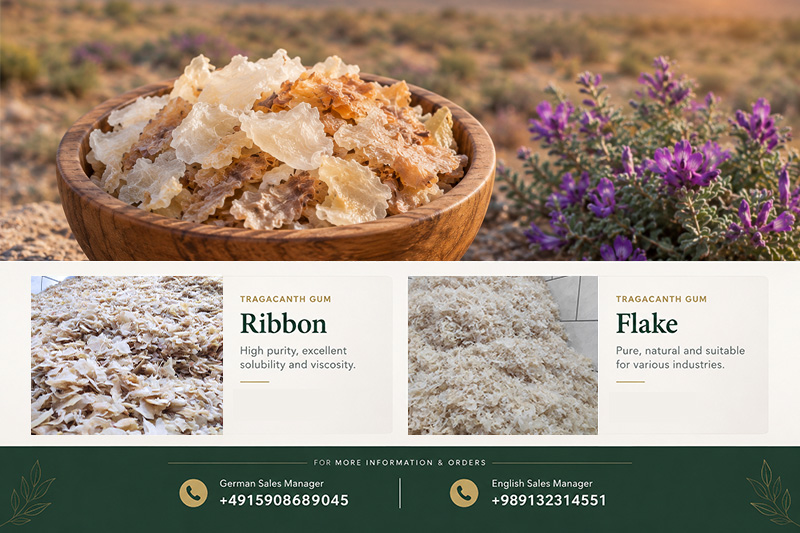
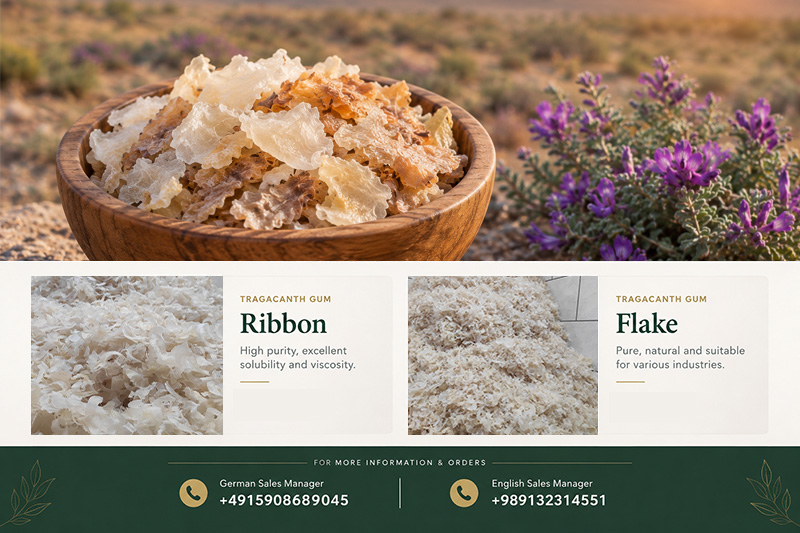
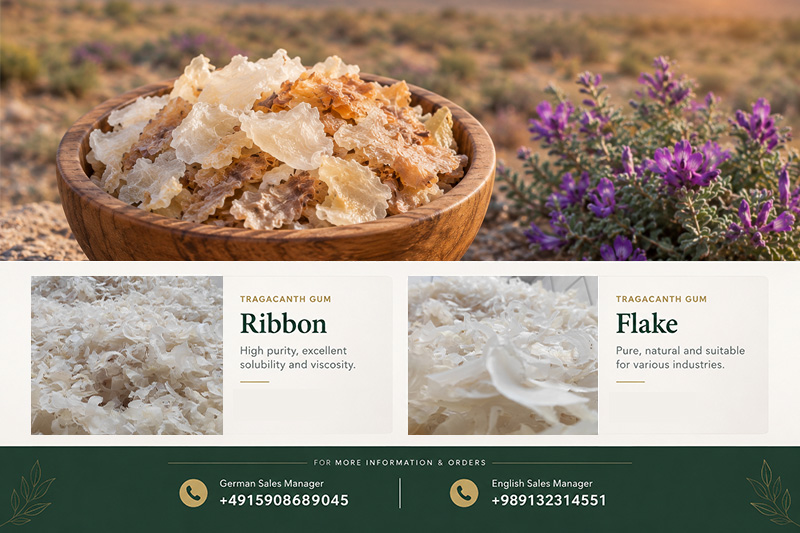
Tragacanth can be supplied in different physical forms. Depending on the product and its degree of processing, buyers may encounter irregular pieces, flakes, strips, stick-type material, granular or clustered forms, and powdered products.
These descriptions are not interchangeable technical grades. Commercial appearance can help identify the form of a product, but it cannot independently establish purity, hydration behavior, viscosity, microbial quality, or suitability for a specific manufacturing process.
Physical appearance
EU specifications describe unground tragacanth as flattened, layered fragments or twisted pieces, generally white to pale yellow, although some pieces may show a reddish tint. Powdered material can also vary in appearance.
Natural variation in color or shape should be assessed against the agreed product specification. A buyer should not accept or reject a commercial batch solely because it differs slightly from a generic photograph or an informal description.
Behavior in water
One of tragacanth's distinguishing characteristics is its ability to swell in water and form a viscous mucilage. Its behavior depends on the material's composition, physical form, preparation method, concentration, and test conditions.
Tragacanth should not be described as completely water-soluble. Its different polysaccharide fractions behave differently in aqueous systems, and swelling is an important part of its functional behavior.
For industrial buyers, this distinction can affect preparation procedures, mixing requirements, process consistency, and the suitability of a particular grade. If a manufacturing process depends on a specific viscosity or hydration profile, the relevant test method and acceptance criteria should be agreed upon before purchase.
Functional performance
Tragacanth has been used as a thickening, stabilizing, and binding ingredient in certain formulations. Its potential usefulness depends on the formulation and the characteristics required by the end product.
For example, a buyer evaluating tragacanth for a food formulation may focus on applicable food-grade specifications and functional performance. An industrial buyer may prioritize different technical parameters, while a pharmaceutical or cosmetic business may need additional documentation and a separate suitability assessment.
These applications should not be treated as evidence that every commercial tragacanth product is suitable for all such uses. Buyers should verify the grade, documentation, regulatory conditions, and performance requirements relevant to their own application.
1.4. What Does Persian Tragacanth Mean?
The phrase Persian Tragacanth is useful in international sourcing discussions because it connects the product with a recognized regional trade identity. Nevertheless, buyers should distinguish between a commercial name, a botanical identification, and a documented country of origin.
When evaluating a supplier, clarify exactly what the name refers to in the offered product. If origin is an essential purchasing criterion, request the relevant origin information and supporting documents where applicable.
For German importers, this distinction is especially relevant when preparing product records, comparing quotations, establishing traceability, and determining which customs or product rules apply to the shipment.
Likewise, the terms “natural,” “premium,” “industrial grade,” and “high quality” do not provide sufficient technical evidence on their own. Such descriptions should be supported by meaningful specifications or documentation relevant to the purchase.
1.5. What Buyers Should Establish Before Purchasing
Before requesting a quotation for Gum Tragacanth, buyers should prepare a clear description of the required material and its intended use. This helps reduce misunderstandings between the purchasing team, supplier, freight provider, and customs broker.
| Purchase Factor |
What to Clarify |
Why It Matters |
| Product identity |
Declared botanical material and product description |
Helps establish that the offered product matches the requirement |
| Commercial form |
Stick-type, granular, cluster-type, or another specified form |
Supports accurate quotation and handling decisions |
| Intended application |
Food, cosmetic, pharmaceutical, or industrial use, as applicable |
Determines which specifications and regulatory conditions need assessment |
| Technical requirements |
Relevant quality parameters, test methods, and acceptance criteria |
Reduces the risk of receiving unsuitable material |
| Origin and traceability |
Declared origin and available supporting records |
Supports supplier evaluation and import documentation |
| Commercial terms |
Quantity, packaging, destination, delivery terms, and payment conditions |
Enables a more meaningful quotation comparison |
A practical example
Consider a hypothetical German ingredient distributor seeking natural gum for resale to industrial customers. A request that simply states “Please quote Persian Tragacanth” leaves several important questions unanswered.
A more useful inquiry would identify the required commercial form, estimated order quantity, intended customer applications, desired specifications, packaging preferences, delivery destination, and required documentation.
The distributor should also state whether a particular grade or analytical profile is mandatory. If the requirements are not yet fully defined, the buyer can ask the supplier to clarify which product information is available before making a final purchasing decision.
⚠ Important technical consideration
Do not select a grade based on appearance, price, or a general claim of quality alone. Request the relevant technical information and confirm that the offered material meets the requirements of the intended application. Any required regulatory or analytical documentation should be agreed upon before the order is finalized.
1.6. Key Takeaways for Importers
Gum Tragacanth is a natural botanical gum with distinctive swelling and thickening properties. Its commercial usefulness depends on the particular material, physical form, technical characteristics, and intended application.
- Confirm the product's identity and declared origin rather than relying on its trade name alone.
- Distinguish between stick-type, granular or cluster-type, and powdered products where relevant.
- Request specifications that match the intended use instead of assuming that every grade is interchangeable.
- Separate commercial descriptions from verified technical and regulatory information.
- Establish the required quantity, packaging, destination, documentation, and delivery terms before comparing quotations.
For German buyers, these initial checks establish a foundation for evaluating suppliers and planning a compliant, commercially practical import transaction.
The next section examines how German businesses can approach international sourcing, assess potential exporters, and establish the information needed for a productive B2B purchasing discussion.
2.1. Why German Businesses Source Tragacanth Gum Internationally
German businesses sourcing Gum Tragacanth may include ingredient distributors, wholesalers, manufacturers, and trading companies serving specialized industrial markets. Their purchasing priorities can differ, but most need a clear understanding of product identity, technical suitability, commercial terms, and the documentation required for their intended use.
International sourcing can give buyers access to a broader range of suppliers and commercial product forms. However, the suitability of a sourcing arrangement depends on the specific product, supplier capabilities, shipment requirements, and the buyer's quality expectations.
For German importers, evaluating an exporter should therefore involve more than comparing the quoted price per kilogram. A commercially attractive quotation may not be suitable if the product specifications are unclear, the documentation is incomplete, or the delivery terms do not match the buyer's requirements.
Before entering into a purchasing agreement, buyers should establish the following:
- Product identity: Confirm that the offered material is the requested type of tragacanth gum.
- Commercial form: Specify the required form, such as stick-type or granular or cluster-type material, subject to availability.
- Technical suitability: Identify the properties and quality parameters relevant to the intended application.
- Documentation: Agree on which technical, commercial, analytical, and regulatory documents are necessary.
- Commercial conditions: Define the quantity, packaging, delivery destination, payment conditions, and applicable delivery terms.
- Import responsibilities: Determine which party will arrange customs clearance, transport, insurance, and any required import procedures.
These checks create a more reliable basis for comparing offers from different suppliers. They also help the buyer identify missing information before a purchase order is issued.
2.2. How to Evaluate a Tragacanth Gum Exporter
Supplier evaluation is particularly important when purchasing a natural material whose characteristics may vary between commercial batches. An exporter should be able to explain the product being offered, identify the information available to support its description, and discuss the commercial requirements of the proposed transaction.
Buyers should avoid assuming that a supplier's website description or general quality statement establishes every technical characteristic of a product. The relevant evidence should be assessed against the actual purchasing specification.
Product information and specification clarity
Begin by asking for a product description that identifies the material and its commercial form. Where available, request a technical data sheet or written specification describing the relevant quality parameters.
The information requested should reflect the intended application. For example, a buyer concerned about processing performance may need details about hydration behavior or viscosity measured under defined conditions. A buyer purchasing raw botanical material may prioritize different physical and analytical characteristics.
Do not assume that every exporter has the same testing facilities or that every product has a standardized specification. Ask which parameters are documented, which tests can be supported, and whether the proposed acceptance criteria can be agreed upon before ordering.
Quality documentation and traceability
Ask the supplier which documents can be provided for the specific product and shipment. Depending on the product, application, and transaction, these may include a technical data sheet, certificate of analysis, batch identification information, or supporting origin documentation where applicable.
A certificate of analysis should be assessed for its relevance to the offered material. Buyers should check which batch it covers, which parameters were tested, which methods were used where stated, and whether the reported results meet the agreed specification.
Not every document is automatically mandatory for every commercial shipment. The buyer should distinguish between legal requirements, contractual requirements, and documents requested as part of an internal quality-assurance process.
Communication and commercial transparency
A useful supplier discussion should clarify uncertainties rather than conceal them. Buyers should expect clear responses about product descriptions, available documentation, packaging information, quotation conditions, and the steps required to confirm an order.
Commercial transparency also means identifying what has not yet been confirmed. If a product's availability, minimum order quantity, testing options, or delivery schedule has not been established, it should be verified before the buyer relies on it.
Export and shipment coordination
Assess whether the proposed transaction has clearly defined responsibilities for preparing the goods, supplying agreed documents, arranging transport, and supporting customs clearance.
The exporter and importer should agree on the delivery term and named place or port where relevant. The applicable Incoterms® rule, if used, should be specified accurately in the quotation or contract.
German buyers should also confirm their own import responsibilities with a qualified customs representative when necessary. A supplier's willingness to discuss export documentation does not by itself establish that the goods meet every German or EU requirement.
2.3. Supplier Evaluation Checklist for German Importers
The following checklist can help procurement teams organize their initial supplier assessment. It is a practical purchasing tool rather than a list of universal legal obligations.
| Evaluation Area |
Questions to Ask |
Evidence to Review |
| Product identity |
What exact material and commercial form are offered? |
Product description and available technical specification |
| Quality parameters |
Which properties can be documented? |
Specification and relevant analytical results |
| Batch traceability |
Can the supplied batch be identified? |
Available batch records and product identification |
| Application suitability |
Does the offered material meet the intended-use requirements? |
Relevant technical and regulatory documentation |
| Packaging |
What packaging options and product identification are available? |
Written packaging description and agreed requirements |
| Commercial terms |
What is included in the quotation? |
Written offer with quantity, delivery terms, and exclusions |
| Import preparation |
Which customs and product requirements apply? |
Confirmed classification and applicable documentation requirements |
| Order coordination |
Which responsibilities belong to each party? |
Agreed purchase order and delivery arrangements |
2.4. Match the Product to the Intended Application
One of the most important sourcing decisions is defining what the buyer needs the gum to do. Different applications can require different physical properties, quality controls, and supporting documents.
A buyer should therefore describe the intended application before requesting a quotation whenever possible. If the application is confidential or still under development, the buyer can provide the relevant technical requirements without disclosing unnecessary proprietary formulation details.
For example, a manufacturer evaluating tragacanth as a thickening ingredient may need to assess its behavior under the intended mixing conditions. A distributor purchasing material for resale may instead need a consistent product description, traceability information, and documentation appropriate for its customer base.
For food, pharmaceutical, nutraceutical, and cosmetic applications, suitability must be assessed separately. A general description of tragacanth's historical or industrial uses does not demonstrate that a particular commercial grade satisfies the requirements of those sectors.
Food-sector buyers should check the relevant provisions of EU food-additive legislation and other applicable food-law requirements. Pharmaceutical and cosmetic buyers should identify the requirements that apply to their product category and intended market. Industrial buyers should define their own technical and safety criteria.
💡 Practical tip for procurement teams
Prepare a short product requirement document before approaching suppliers. Include the intended use, preferred commercial form, required quality parameters, order quantity, packaging needs, destination, and documentation expectations. This makes supplier responses easier to compare on an equivalent basis.
2.5. Verify German and EU Import Requirements Before Ordering
When sourcing tragacanth gum from outside the European Union, buyers should establish the customs and product requirements that apply to the exact shipment. These requirements cannot be determined from the product's trade name alone.
The relevant checks may include customs classification, applicable duties, import VAT, customs declaration requirements, product-specific restrictions, and any additional controls associated with the product's intended use or origin.
The German Federal Portal explains that goods imported into Germany from outside the EU must undergo the applicable customs process before release for free circulation. Depending on the goods and circumstances, customs duties, import VAT, and supporting documentation may also be relevant.
Use the following official resources as starting points:
These resources provide general guidance. They do not establish that a particular certificate, phytosanitary document, import authorization, or inspection is automatically required for every tragacanth shipment. The exact obligations must be verified against the product's customs classification, origin, form, intended use, and applicable legislation.
Buyers should also establish whether the product will be imported for food use, another regulated application, or general industrial use. Intended use can materially affect the relevant compliance assessment.
2.6. Common Sourcing Mistakes to Avoid
Even experienced purchasing teams can encounter avoidable problems when the purchasing specification is incomplete or commercial assumptions remain unconfirmed.
- Comparing prices without comparing specifications: Two quotations may describe products that differ in form, quality parameters, or documented suitability.
- Assuming a trade name proves origin: Request supporting information when the declared country of origin is important.
- Accepting broad quality claims without evidence: Identify the parameters that matter to the application and request relevant documentation.
- Assuming every grade is suitable for food or pharmaceutical use: Verify the applicable requirements for the specific material and market.
- Leaving customs classification until shipment: Establish the likely classification and applicable import requirements before finalizing the transaction.
- Overlooking delivery-term details: Clarify who arranges transport, who bears the relevant costs and risks, and where the agreed delivery obligation is fulfilled.
- Relying on unconfirmed lead times or stock claims: Obtain written confirmation of availability and timing before making dependent commercial commitments.
Careful sourcing does not eliminate every risk, but it gives the buyer a more reliable basis for making decisions and resolving uncertainties before shipment.
2.7. Preparing a Sourcing Inquiry for Pars Ketira
Businesses interested in purchasing tragacanth gum from Pars Ketira can make their initial inquiry more useful by providing a clear description of their requirements.
Where possible, include the following information:
- Required product: Gum Tragacanth or Persian Tragacanth.
- Preferred commercial form: stick-type, granular or cluster-type, or another specified form.
- Intended application and any mandatory technical requirements.
- Requested order quantity and expected purchasing frequency, if known.
- Destination country and delivery location.
- Packaging preferences and handling requirements.
- Required technical documents, analytical records, or regulatory evidence.
- Preferred delivery terms and any relevant purchasing conditions.
These details help establish the scope of the inquiry. Availability, specifications, minimum order quantities, packaging options, delivery schedules, and quotation conditions must be confirmed directly rather than assumed in advance.
Looking for a Tragacanth Gum Export Supplier for Germany?
Contact our sales team to discuss product specifications, available grades, documentation, and your purchasing requirements.

2.8. Key Takeaways
Successful international sourcing begins with a clear product requirement and a structured supplier evaluation. German buyers should compare technical specifications, supporting documents, commercial terms, and import requirements rather than relying on price or product descriptions alone.
For a more informed purchasing decision, confirm the product's identity, define the intended application, request relevant documentation, and establish the responsibilities of the exporter and importer before committing to a shipment.
The next section examines the commercial forms and grades of tragacanth gum, including the distinctions buyers should consider when comparing stick-type and granular or cluster-type material.
When purchasing Gum Tragacanth for the German market, buyers should distinguish between the product's physical form, its quality grade, and its suitability for a particular application. These are related but separate considerations.
The physical form describes how the material is presented commercially. A grade or specification describes defined product characteristics and acceptance criteria. Application suitability concerns whether the material meets the technical, quality, and regulatory requirements of the buyer's intended use.
For example, two products may both be described as natural tragacanth gum but differ in appearance, particle form, processing history, or documented functional properties. Their suitability for a particular manufacturing process cannot be established from the product names alone.
Pars Ketira supplies and exports tragacanth gum, including stick-type and granular or cluster-type products, subject to actual availability. Buyers should confirm the exact form available for their inquiry and request the relevant product information before placing an order.
3.2. Stick-Type Tragacanth Gum
Stick-type Tragacanth Gum is a commercial form in which the material is presented as elongated or strip-like pieces. The appearance and dimensions of natural gum pieces can vary, so buyers should agree on the description and selection criteria required for their purchase.
For importers, wholesalers, and ingredient distributors, the physical form may affect product presentation, sorting, handling, storage, and subsequent processing. However, appearance alone does not demonstrate chemical composition, purity, hydration behavior, or suitability for a regulated application.
Before purchasing stick-type material, buyers should clarify the following:
- The supplier's exact commercial description of the product.
- The acceptable range of physical appearance and piece characteristics, where relevant.
- Whether the material is supplied in its stated natural form or has undergone additional processing.
- Which quality parameters are documented and which can be assessed against an agreed specification.
- The intended application and any specific technical requirements.
- The packaging and product identification information available for the shipment.
If the buyer needs stick-type gum for resale, visual consistency and a clear product description may be important commercial considerations. If the material will be processed further, the buyer may also need to evaluate its behavior during preparation and processing.
Do not assume that every stick-type product has identical dimensions, color, quality, or performance. These characteristics should be confirmed against the actual product offered.
3.3. Granular or Cluster-Type Tragacanth Gum
Granular or cluster-type Tragacanth Gum is another commercial form that buyers may encounter. The term describes the material's physical presentation and should be clarified with the supplier to ensure that both parties are referring to the same product.
Buyers should not assume that granular or cluster-type material has a particular particle-size distribution, moisture content, purity level, or processing history unless those properties are stated in a verified specification.
For procurement teams, the key questions include:
- How does the supplier define the granular or cluster-type product?
- Are particle characteristics or size ranges specified?
- Has the material undergone sorting, cleaning, grinding, or another processing step?
- Which analytical or physical quality parameters are available?
- Does the product meet the buyer's handling and processing requirements?
- What packaging format is available and appropriate for the intended shipment?
These questions are particularly useful when a buyer needs a consistent raw material for repeated orders. A clear specification helps the purchasing team assess whether successive shipments meet the agreed requirements, subject to appropriate verification.
Granular or cluster-type material should not automatically be described as a standardized industrial grade. Its suitability depends on the actual product characteristics and the buyer's requirements.
3.4. Powdered Tragacanth Gum and Further Processing
Powdered Tragacanth Gum is a processed physical form that may be relevant to buyers seeking material for particular formulation or manufacturing processes. It should be distinguished from naturally occurring pieces and from granular or cluster-type material.
Grinding can change physical characteristics such as particle size and surface area. These changes may influence handling, dispersion, hydration, and the preparation of a usable formulation. The actual effect depends on the material and the processing conditions.
Buyers considering powdered material should determine whether a powder product is available and whether its specifications match the intended application. If particle size is important, request the applicable measurement method and specified range rather than relying on general descriptions such as fine powder or micronized gum.
Additional processing does not automatically establish a higher quality grade. Buyers should assess the resulting product against their technical requirements and the documentation available.
Likewise, do not assume that a powdered product is easier to disperse, more effective, or more suitable than a piece-form product in every formulation. These outcomes depend on the application, preparation method, and actual product characteristics.
The following table summarizes the principal purchasing considerations for different physical forms. It is a general procurement guide, not a verified specification sheet for every Pars Ketira product.
| Commercial Form |
Typical Description |
Key Buyer Considerations |
Information to Confirm |
| Stick-type |
Elongated or strip-like pieces |
Appearance, sorting, handling, and processing needs |
Commercial description, physical characteristics, quality criteria, and packaging |
| Granular or cluster-type |
Irregular granular pieces or clusters |
Consistency of the supplied form and intended processing |
Product definition, any specified particle characteristics, and applicable quality parameters |
| Powdered |
Material processed into powder |
Particle characteristics, dispersion, hydration, and handling |
Processing status, particle-size specification where relevant, and technical data |
Availability of a particular form must be confirmed directly with the supplier. The table does not imply that every form is continuously available or offered with a standardized grade.
3.6. Understanding Tragacanth Gum Grades
The term grade should refer to a defined set of product characteristics or acceptance criteria rather than an unsupported quality label.
Commercial descriptions such as premium, high quality, industrial grade, food grade, or pharmaceutical grade may have different meanings depending on the supplier, market, and applicable standard. Buyers should ask what each description means for the actual product being offered.
A useful product specification should identify the material and state the parameters that are relevant to the purchase. Depending on the intended application, these may include physical characteristics, moisture, foreign matter, relevant analytical results, functional performance, or other agreed quality criteria.
Not every parameter applies to every product, and no single list of values should be treated as universally appropriate for all tragacanth gum applications.
General commercial grade versus application-specific suitability
A general commercial grade may describe a product's appearance or sorting category. Application-specific suitability requires a separate assessment of whether the material meets the relevant technical and regulatory requirements.
For example, a product that is suitable for a particular industrial process is not automatically suitable for use as a food additive. Similarly, a product marketed for food use should not be assumed to meet pharmaceutical or cosmetic requirements without the necessary assessment and supporting evidence.
Buyers should request clarification when a supplier uses a grade name without an accompanying specification. The goal is to establish measurable or otherwise clearly defined requirements that can be evaluated before purchase and, where appropriate, during incoming inspection.
3.7. Application Suitability: Food, Pharmaceutical, Cosmetic, and Industrial Uses
Tragacanth gum has established uses as a functional ingredient in certain formulations. However, its use in a specific sector depends on the material's characteristics, the formulation, the applicable legal framework, and the documentation available for the offered product.
The following overview identifies questions buyers should consider. It does not certify that any particular Pars Ketira product is approved or suitable for the applications listed.
Food and beverage applications
Tragacanth is identified as food additive E 413 in the relevant EU food-additive framework. Its use in food products is subject to the applicable conditions of use, purity specifications, and other relevant food-law requirements.
German food manufacturers should verify that the intended application is permitted under the applicable EU legislation and that the supplied material satisfies the relevant specifications. They should also establish which supplier documentation and analytical controls are necessary for their quality-management system.
A supplier's general description of tragacanth as a food ingredient is not a substitute for checking the actual product and the applicable legal requirements.
Pharmaceutical and nutraceutical applications
Businesses considering tragacanth for pharmaceutical or nutraceutical applications should establish the relevant product category and applicable quality framework before purchasing.
Requirements can differ according to the intended use, dosage form, jurisdiction, and applicable standards. Buyers should identify any required pharmacopoeial specification, analytical testing, traceability documentation, or other controls with their quality and regulatory teams.
Do not assume that a commercial product meets pharmaceutical requirements simply because tragacanth has been used in pharmaceutical formulations. The suitability of the actual material must be established separately.
Cosmetic applications
Cosmetic ingredient buyers should assess the product against the requirements of the intended formulation and the applicable EU cosmetics framework. Relevant considerations may include ingredient identity, quality documentation, formulation performance, and the manufacturer's own safety and compliance processes.
The fact that a natural gum can serve a functional role in some cosmetic formulations does not establish that every commercial grade is appropriate for every cosmetic product.
Industrial applications
Industrial manufacturers may evaluate tragacanth for specialized formulation or processing purposes where its functional characteristics are relevant. The specific technical criteria will depend on the process and desired performance.
Before purchase, define the properties that affect the manufacturing process and establish how they will be evaluated. If performance depends on hydration, viscosity, compatibility, or other measurable characteristics, the test conditions should be specified clearly.
3.8. Application Requirements and Buyer Checks
| Buyer Sector |
Potential Evaluation Priorities |
Recommended Verification |
| Food manufacturing |
Permitted use, relevant purity criteria, functionality, and quality controls |
Check applicable EU food-additive rules and product documentation |
| Pharmaceutical and nutraceutical businesses |
Applicable quality standards, analytical requirements, and traceability |
Confirm requirements with the relevant quality and regulatory teams |
| Cosmetic manufacturers |
Formulation compatibility, ingredient identity, and relevant compliance documentation |
Assess against the intended cosmetic application and applicable EU requirements |
| Industrial manufacturers |
Process performance, physical properties, handling, and consistency |
Define application-specific technical parameters and test conditions |
| Ingredient distributors |
Clear product descriptions, traceability, customer requirements, and commercial consistency |
Review specifications and confirm the documentation needed by intended customers |
3.9. Comparing Tragacanth with Other Botanical Gums
German importers may evaluate tragacanth alongside other hydrocolloids, including guar gum, gum arabic, and xanthan gum. These materials should not be treated as interchangeable simply because they can be used in some overlapping applications.
They differ in origin, composition, functional behavior, processing requirements, and applicable specifications. The appropriate choice depends on the performance needed in the intended formulation and the relevant regulatory conditions.
| Material |
General Identity |
What Buyers Should Evaluate |
| Tragacanth gum |
Natural exudate from certain Astragalus species |
Swelling, mucilage formation, product form, and application-specific performance |
| Guar gum |
Galactomannan obtained from guar seeds |
Viscosity behavior, hydration conditions, and formulation requirements |
| Gum arabic |
Plant exudate obtained from specified Acacia species |
Solubility, emulsification requirements where relevant, and application suitability |
| Xanthan gum |
Microbially produced polysaccharide |
Rheological behavior, formulation conditions, and applicable specifications |
This comparison provides a general orientation rather than a performance ranking. A meaningful comparison requires application-specific testing and specifications. A buyer should not substitute one gum for another without confirming that the change meets the required technical and regulatory conditions.
Before selecting a commercial form or grade, buyers should document the criteria that will determine whether the product is acceptable.
- Identify the intended application and relevant regulatory category.
- Specify the preferred physical form and confirm that it is available.
- Request the current product specification and identify any missing parameters.
- Determine whether functional testing is needed before approval.
- Agree on quality acceptance criteria and the supporting documentation.
- Confirm packaging, storage, handling, and transport considerations.
- Check import requirements for the exact product and intended use.
- Compare quotations only after confirming that the offers cover equivalent requirements.
Where uncertainty remains, buyers should resolve it with the supplier and their technical or regulatory advisers before committing to a purchase. If a sample is offered and available, any evaluation should use agreed criteria representative of the intended application.
3.11. Key Takeaways
Tragacanth gum is available in different physical forms, but a commercial form does not by itself establish a quality grade or suitability for a particular application.
Stick-type and granular or cluster-type products should be described clearly in the purchasing specification. Powdered material, where available, should be evaluated separately because processing can affect physical characteristics and handling behavior.
German and international buyers should establish the intended application, confirm the relevant product characteristics, and request appropriate documentation before selecting a supplier. Food, pharmaceutical, cosmetic, and industrial uses require separate assessments rather than assumptions based on the general properties of tragacanth.
The next section will examine the technical specifications and quality documentation that buyers should request when evaluating Gum Tragacanth for commercial import.
Section 5: Export Preparation, Packaging, and Shipment Planning for Germany
Once a German buyer and supplier have agreed on the product form, intended application, technical specifications, and quality documentation, the next step is to prepare the shipment. Export preparation for Gum Tragacanth involves more than placing the material in bags or cartons. The product must be packed to protect its condition, identified clearly, documented consistently, and coordinated with the buyer’s import and receiving procedures.
For Pars Ketira and prospective German business partners, shipment planning should begin before the final cargo is prepared. The buyer and supplier should agree on packaging, labeling, batch identification, transport arrangements, required documents, and the allocation of responsibilities. These details help reduce misunderstandings and make the shipment easier to receive, inspect, and store.
5.1 Confirm the Product Before Preparing the Shipment
Export preparation should be based on the exact product agreed upon in the purchase order or sales contract. The description should identify the commercial form and any agreed quality requirements instead of relying on a broad description such as “natural gum.” Stick-type and granular or cluster-type Tragacanth may have different handling, packing, inspection, and storage considerations.
Before packing begins, the buyer and supplier should confirm the following details:
- Product identity: the agreed commercial name and botanical or regulatory identity where applicable.
- Commercial form: stick-type, granular or cluster-type, or another form specifically confirmed by the supplier.
- Quality requirements: the specification, acceptance criteria, and any agreed inspection procedure.
- Order quantity: the quantity and unit of measurement stated in the purchase order.
- Packaging format: the agreed inner and outer packaging, package size, and total number of packages.
- Batch information: the identification system used to connect the shipment with its quality records.
- Intended use: food, pharmaceutical, cosmetic, or industrial use, where this affects the required specification and compliance checks.
These details should be settled before the shipment is finalized. If the buyer requires a particular grade, package size, or document, it should be included in the written agreement rather than assumed to be standard for every order.
5.2 Choosing Packaging for Tragacanth Gum
Packaging should protect the product from avoidable contamination, physical damage, and environmental exposure during storage and transport. The most appropriate solution depends on the commercial form, quantity, route, expected transit conditions, and buyer requirements. Natural plant exudates can be affected by unsuitable handling and storage, so packaging decisions should be based on the product’s characteristics rather than appearance alone.
| Packaging Consideration |
Purpose |
What the Buyer Should Confirm |
| Inner packaging |
Provides a layer of protection between the product and the outer package. |
Material suitability, closure method, cleanliness, and compatibility with the intended use. |
| Outer bags, cartons, or containers |
Supports handling, stacking, and protection during transportation. |
Strength, package dimensions, net weight, and resistance to handling damage. |
| Moisture protection |
Helps limit exposure to moisture when suitable protective packaging is used. |
Required barrier properties, closure integrity, and any storage precautions. |
| Batch and package identification |
Makes it easier to identify and trace the material. |
Batch or lot number, product description, package count, and consistency with shipping documents. |
| Palletization, if applicable |
Facilitates loading, unloading, and movement of multiple packages. |
Pallet dimensions, load stability, wrapping, total gross weight, and applicable transport requirements. |
The packaging format, package weight, and pallet configuration should be agreed with the supplier. They should not be assumed to be available as standard options without confirmation. For products intended for food, pharmaceutical, or cosmetic applications, the buyer should also verify that the proposed packaging is appropriate for the intended use and applicable requirements.
5.3 Moisture Protection and Storage During Transit
Moisture management is an important consideration when transporting and storing natural gums. Exposure to unsuitable conditions may affect the product’s handling characteristics or contribute to quality deterioration. However, the appropriate moisture specification and protective measures depend on the actual product, its condition, the intended application, and the agreed test method.
Before shipment, the buyer and supplier should discuss:
- Whether a moisture-related acceptance criterion is required and how it will be measured.
- Whether inner liners, sealed packaging, or other protective measures are appropriate for the product.
- How the cargo will be protected from rain, condensation, and wet handling areas.
- Whether the selected transport and storage arrangements may expose the cargo to significant temperature or humidity changes.
- How the shipment should be stored after arrival and before the packages are opened.
Packaging can help reduce exposure, but it should not be treated as a substitute for suitable storage and transport practices. Buyers should request practical storage guidance for the specific product supplied and ensure that the receiving warehouse can maintain appropriate conditions.
5.4 Labeling and Batch Traceability
Clear labeling helps the importer identify the shipment, reconcile the received quantity with the shipping documents, and connect each package with the relevant quality records. Label content should be agreed before dispatch, particularly where the buyer has internal warehouse procedures or requirements linked to the intended application.
Depending on the transaction and applicable rules, the parties may agree to include the following information:
- Product name and commercial form.
- Supplier or exporter identification.
- Batch or lot number.
- Net weight and, where needed, gross weight.
- Package number or package count.
- Country of origin, when required and properly established.
- Storage and handling instructions, where appropriate.
- Any additional labeling information required by the buyer or applicable regulations.
Labels must match the actual contents and supporting documents. Origin statements, food-related claims, quality designations, and regulatory references should not be added unless they are accurate and supported. The labeling requirements for a raw material may differ according to its classification, intended use, and whether it is being placed on the market as a food ingredient or for another purpose.
5.5 Export and Import Documentation
International shipments normally require commercial and transport documentation, while additional documents depend on the product, country of origin, customs classification, intended use, and specific import conditions. German buyers should confirm the document list with their customs representative or relevant authorities before the cargo is dispatched.
| Document or Record |
Typical Function |
Points to Verify |
| Commercial invoice |
Records the transaction, parties, product description, quantity, and commercial value. |
Ensure that the description, quantities, currency, and sale terms agree with the order. |
| Packing list |
Describes the packages and their contents. |
Confirm package count, net and gross weights, and any package identifiers. |
| Transport document |
Provides shipment information according to the transport method. |
Check consignee details, routing, shipment references, and the applicable transport document. |
| Certificate of origin, if required |
Supports a declaration of origin where the relevant procedure calls for it. |
Confirm the applicable origin rules, issuing process, and whether the buyer or customs procedure requires it. |
| Certificate of Analysis (CoA), if agreed or required |
Records test results for a defined batch against specified parameters. |
Check the batch reference, analytical methods, results, and agreed acceptance criteria. |
| Additional regulatory or inspection documents, where applicable |
Addresses product-specific or route-specific requirements. |
Verify whether any health, phytosanitary, conformity, or other official documentation actually applies. |
This table is a planning checklist, not a statement that every listed document is mandatory for every shipment. For example, the need for a certificate of origin or a phytosanitary document must be determined from the specific circumstances and applicable rules. Buyers should not rely on a generic document list in place of a product-specific import review.
For current tariff, origin, and import-procedure checks, consult the European Commission’s Access2Markets portal. German importers can also review the relevant government guidance on customs import declarations. The correct customs classification should be confirmed for the exact product rather than inferred from the general name “Gum Tragacanth.”
5.6 Aligning Shipment Documents with Product Specifications
One preventable source of import delays is a mismatch between the commercial paperwork, package labels, and quality documents. Even when the cargo itself is correct, inconsistencies can complicate customs clearance, warehouse receiving, or internal quality approval.
Before dispatch, the supplier and buyer should compare the following details across the applicable records:
- Product name and commercial form.
- Order number and shipment reference.
- Batch or lot number, where applicable.
- Number of packages and declared weights.
- Buyer, seller, consignee, and delivery information.
- Country-of-origin information where declared.
- Certificate of Analysis references and the specification used for evaluation.
If the product is being purchased for a regulated or quality-sensitive application, the buyer should establish whether the documentation must be approved before shipment. Where pre-shipment approval is part of the contract, the parties should define who reviews the documents and what happens if a discrepancy is found.
5.7 Selecting a Transport Method
The most suitable transport method depends on shipment size, destination, urgency, cost, route availability, cargo handling needs, and the agreed delivery terms. There is no single transport solution that is best for every Gum Tragacanth order.
| Planning Factor |
Questions for the Buyer and Supplier |
| Shipment size |
Is the order a sample, a small commercial shipment, or a larger cargo requiring consolidated or dedicated transport? |
| Transit time |
What delivery window is needed, and how much time should be allowed for export handling and import clearance? |
| Cargo handling |
Will the chosen route expose the packages to moisture, repeated handling, or conditions requiring additional protection? |
| Total landed cost |
What are the expected transport, insurance, customs, handling, and destination charges under the agreed delivery terms? |
| Delivery responsibilities |
Which party arranges transport, handles export and import formalities, and bears the relevant costs and risks? |
Where the parties use Incoterms®, the specific rule and named place should be stated clearly in the sales contract or order documentation. The buyer should understand which party is responsible for transport arrangements, insurance where applicable, customs formalities, and the transfer of risk under the chosen term. Import duties, taxes, and other charges should be checked for the actual transaction rather than estimated from the product name alone.
5.8 Pre-Shipment Inspection and Release
A pre-shipment review can help identify avoidable problems before the cargo leaves the supplier. The level of inspection should match the commercial agreement and the buyer’s risk tolerance. For some transactions, a review of packaging and documents may be sufficient; other orders may require a sample review, laboratory testing, or an inspection performed under an agreed procedure.
A practical pre-shipment checklist may include:
- Confirming that the product form and quantity match the purchase order.
- Checking packaging integrity and package identification.
- Confirming that agreed batch and quality records are available.
- Reviewing the Certificate of Analysis when one is part of the agreement.
- Checking that the commercial invoice and packing list are consistent.
- Confirming the shipment plan, collection arrangements, and agreed delivery term.
- Recording any deviations and obtaining written approval where required.
Inspection does not automatically guarantee that a shipment will comply with every requirement in Germany. Regulatory compliance depends on the actual product and its intended use, while contractual acceptance depends on the agreed specifications and inspection terms. Both should be considered before dispatch.
5.9 Arrival in Germany: Receiving and Storage
Shipment planning should include the receiving process at the German destination. The importer should prepare a suitable location for unloading and storage, ensure that personnel can identify the consignment, and define the steps for checking received packages against the order and shipping documents.
After arrival, the receiving team should consider:
- Verifying package count and visible packaging condition.
- Comparing delivered quantities with the packing list and purchase order.
- Recording damaged, wet, opened, or otherwise questionable packages before routine storage.
- Checking batch identifiers against the relevant quality documentation.
- Following the supplier’s agreed storage guidance.
- Keeping material under appropriate status controls if the buyer’s quality system requires inspection or approval before use.
If damage or a discrepancy is discovered, the buyer should document it promptly and follow the notification and claims procedure agreed in the contract. Photographs, package identifiers, delivery records, and relevant test results may help the parties assess the issue. Any time limits for claims or formal notifications should be checked against the purchase agreement.
5.10 Questions to Resolve Before Confirming an Export Order
To avoid last-minute changes, German buyers should request clear answers to these questions before confirming the shipment:
- Which exact commercial form and specification are being supplied?
- What packaging format and package weight have been agreed?
- How will batches be identified and linked to quality records?
- Which documents will be provided with the shipment?
- Are any additional import or product-specific documents required for the actual transaction?
- Who arranges transport and handles the relevant customs procedures?
- Which delivery term and named place apply?
- What is the agreed procedure for pre-shipment approval, if applicable?
- How should the buyer inspect and report damage or non-conformity after arrival?
- What storage conditions should be maintained after delivery?
Section 5 Summary
Reliable Gum Tragacanth export preparation requires coordination between product specifications, protective packaging, traceable labeling, consistent documentation, transport arrangements, and destination handling. German buyers should confirm these elements in writing before dispatch and verify any regulatory obligations that apply to the exact product and intended use.
For Pars Ketira buyers, the next practical step is to provide the desired commercial form, application, quantity, packaging preferences, destination, and any documentation requirements. These details allow the supplier and buyer to discuss the order on a clearly defined basis without assuming unconfirmed specifications or services.
Planning a Gum Tragacanth Shipment to Germany?
Contact Pars Ketira to discuss your required product form, packaging preferences, quality documentation, and export order requirements.
Section 6: Import Compliance, Customs Clearance, and Regulatory Considerations for Gum Tragacanth in Germany
For German companies sourcing Persian Gum Tragacanth from an international supplier, regulatory planning is an essential part of procurement. Before placing an order, the importer should establish how the product will be classified, what it will be used for, which import requirements apply, and which party is responsible for each stage of the shipment.
Gum Tragacanth is a natural plant-derived material, but its natural origin does not automatically exempt it from customs, food safety, chemical safety, labeling, or other applicable requirements. The rules depend on the product’s identity, processing status, intended application, country of origin, and the conditions under which it enters the European Union.
This section provides a practical framework for evaluating these issues. It is not a substitute for a product-specific customs or regulatory assessment. German importers should verify the current requirements with their customs representative and the relevant authorities before dispatch.
6.1 Establish the Intended Use Before Importing
The intended use is one of the first details a buyer should establish. A material intended for use as a food ingredient may face different requirements from a product intended for cosmetics, pharmaceuticals, technical applications, or further industrial processing.
| Intended Application |
Key Compliance Questions |
Buyer Action |
| Food ingredient |
Does the product meet the applicable food additive or ingredient requirements for the intended use? |
Confirm identity, applicable specifications, permitted use conditions, purity criteria, and relevant food safety obligations. |
| Pharmaceutical or medicinal applications |
Does the material need to meet a particular pharmacopoeial, compendial, or customer-specific standard? |
Define the required grade, test methods, documentation, and supplier qualification process before ordering. |
| Cosmetics |
What ingredient identity, safety assessment, quality, and documentation requirements apply to the finished cosmetic product? |
Confirm the raw material’s suitability and the documentation needed by the cosmetic manufacturer. |
| Industrial or technical use |
Are there application-specific quality, safety, transport, or contractual requirements? |
Specify the performance requirements and any applicable safety or environmental obligations. |
These categories are not interchangeable. A supplier’s ability to offer a natural Gum Tragacanth product does not by itself establish that the material is suitable for food, pharmaceutical, cosmetic, or any other regulated application. Buyers should obtain evidence appropriate to their intended use before approving the material for production.
6.2 Food-Grade Tragacanth and the E 413 Framework
Within the European Union, tragacanth is identified as food additive E 413 in the relevant food additive framework. The applicable specifications and conditions of use must be considered when the material is purchased for food applications. The fact that a product is commonly known as Gum Tragacanth does not automatically demonstrate compliance with the requirements for use as a food additive.
German food manufacturers and importers should verify the following points when evaluating a proposed food-grade supply:
- Identity: confirm that the material corresponds to the substance required for the intended application.
- Applicable specifications: review the relevant EU specification and any additional requirements that apply to the intended use.
- Permitted use: confirm that the proposed use and food category are permitted under the applicable rules.
- Purity and safety: establish which analytical parameters and acceptance limits are relevant to the product.
- Traceability: confirm that the supplied batch can be linked to the corresponding quality records.
- Supplier documentation: determine which records the buyer needs to approve the raw material within its own quality system.
The European Commission’s Regulation (EU) No 231/2012 sets specifications for food additives listed in the relevant EU framework, including tragacanth. Importers should check the current consolidated legislation and any subsequent amendments rather than relying solely on an older copy or a supplier’s general product description.
Food additive authorization and specification compliance should not be confused with blanket approval for every food application. The importer remains responsible for confirming that the specific use is permitted and that all relevant legal obligations are met.
6.3 Customs Classification and Tariff Verification
Customs classification is an important step because it affects how the shipment is declared and which tariff and regulatory measures may apply. The correct classification must be determined from the product’s actual characteristics and the relevant customs nomenclature. A general commercial description such as “natural gum” or “plant exudate” is not enough to establish a definitive customs code.
Before shipment, the German importer should work with a customs specialist to review:
- The precise product description and commercial form.
- The material’s composition and relevant manufacturing or processing details.
- The applicable Combined Nomenclature and, where relevant, TARIC classification.
- The declared country of origin and any applicable origin rules.
- Potential customs duties, import taxes, restrictions, or other measures.
- Whether additional product-specific documents or controls may apply.
Do not select a tariff code solely because another company used it for a product with a similar name. Small differences in product identity, preparation, or presentation can affect classification. Where the classification is uncertain or the commercial consequences are significant, the importer should consider obtaining formal advice or seeking a Binding Tariff Information decision through the appropriate customs procedure.
The European Commission’s Access2Markets portal can help businesses investigate tariff and import requirements. The final classification and declaration remain matters for the importer and its customs representative to verify against the actual shipment and current rules.
6.4 Country of Origin and Origin Documentation
Country of origin is a distinct concept from the country from which a shipment is dispatched. A product may be shipped through a third country without acquiring that country’s origin. Origin determination depends on the applicable rules and the facts of the product’s production or processing.
For a Gum Tragacanth shipment, the buyer should ensure that the origin information used in commercial and customs documentation is accurate and supported. The parties should distinguish between:
- Country of dispatch: the country from which the shipment begins its transport.
- Country of origin: the country determined under the applicable origin rules.
- Preferential origin: origin status that may provide a tariff benefit only where a relevant preferential arrangement and its rules apply.
A certificate of origin may be requested by a buyer, bank, customs procedure, or other relevant party, but it should not be assumed to be mandatory for every shipment. The importer should confirm whether a certificate or other origin evidence is required and what form it must take.
6.5 Plant Health and Other Official Controls
Because Gum Tragacanth is derived from a plant, importers may wonder whether phytosanitary certification or plant-health controls apply. The answer should be established for the exact product and its classification. Requirements for live plants, planting material, certain plant products, and processed plant-derived materials are not necessarily the same.
Before dispatch, the importer should verify whether the particular product is subject to:
- Plant-health or phytosanitary requirements.
- Official border controls or other product-specific inspection measures.
- Restrictions connected to the product’s origin or route.
- Food safety controls, where the product is imported for food use.
- Additional documentation required under the applicable import regime.
Neither the supplier nor the importer should assume that a phytosanitary certificate is always required or that it is never required. The applicable rule must be checked against the actual product, origin, and import conditions. Any required certificate or official inspection should be arranged before shipment, not after the cargo reaches the destination.
6.6 Customs Declaration and Importer Responsibilities
Commercial shipments entering Germany generally need to be declared through the applicable customs procedure. Depending on the arrangement, the importer may complete the declaration directly or use a customs representative. Using a representative does not remove the need for the importer to provide accurate information and understand its responsibilities.
The importer and its representative should establish in advance:
- Who will act as importer and who will submit the customs declaration.
- Which identification and registration details are required for the transaction.
- Which product description, classification, origin, and value will be declared.
- Which supporting documents must be available at the time of declaration.
- How customs duties, import VAT, and other applicable charges will be handled.
- Whether any special procedure or additional control applies to the goods.
The commercial invoice, packing list, transport document, and other supporting records should be consistent. If the customs declaration requires additional details, the importer should obtain them from the supplier before the cargo is dispatched.
6.7 Product Safety, Contaminants, and Quality Records
For buyers purchasing Gum Tragacanth for food or other quality-sensitive uses, import compliance also involves establishing that the material is suitable for the intended purpose. The relevant checks depend on the application and the applicable standards. A Certificate of Analysis can provide useful batch-specific information, but its value depends on the parameters tested, methods used, and acceptance criteria against which the results are evaluated.
Buyers should consider whether their risk assessment requires documentation or testing for:
- Identity and agreed physical characteristics.
- Foreign matter and cleanliness.
- Moisture or other relevant composition parameters.
- Microbiological parameters appropriate to the intended application.
- Relevant contaminants or residues, where applicable.
- Viscosity, hydration behavior, or other functional properties when these affect performance.
Not every parameter is mandatory for every product or use. The importer should establish the relevant legal requirements and contractual acceptance criteria rather than apply a generic checklist without considering the material’s intended use.
For food applications, the supplier’s documentation should be evaluated alongside the buyer’s own supplier approval and food safety procedures. If the material is intended for pharmaceutical, cosmetic, or industrial use, the applicable quality framework may be different. Buyers should specify the required documents and tests before confirming the order.
6.8 Claims, Labeling, and Intended-Use Statements
Descriptions used in product labels, specifications, invoices, and marketing materials should accurately represent the material supplied. Claims such as “food grade,” “pharmaceutical grade,” “organic,” “high purity,” or “compliant with EU requirements” should only be used when they are supported by appropriate evidence and are relevant to the specific product.
Before approving labels or product documentation, buyers should confirm:
- That the commercial product name accurately identifies the material.
- That any grade designation is defined and supported.
- That regulatory references apply to the actual product and intended use.
- That origin claims are accurate and appropriately documented.
- That any required language, labeling, or information rules have been considered.
For raw materials supplied to a manufacturer, the labeling requirements may differ from those applicable to a finished consumer product. The importer should determine which rules apply to the material in its actual commercial context.
6.9 Build a Compliance Checklist Before Ordering
A written compliance checklist helps the buyer identify unresolved issues before committing to shipment. It also gives the supplier a clear picture of the documents and product details required for the transaction.
| Verification Item |
Responsible Party to Consult |
Recommended Outcome |
| Intended application and product specification |
Buyer’s technical or quality team and supplier |
Written specification and agreed acceptance criteria |
| Food additive or other sector-specific requirements |
Regulatory specialist or relevant authority |
Confirmation of applicable rules for the intended use |
| Customs classification and tariff measures |
German importer and customs representative |
Verified classification and an assessment of applicable charges and measures |
| Origin and supporting evidence |
Importer, supplier, and relevant issuing body if needed |
Accurate origin information and any required supporting document |
| Plant-health or other official controls |
Importer and competent authority |
Confirmation of whether any certificate, control, or restriction applies |
| Shipment and customs documentation |
Supplier, importer, and transport or customs representatives |
Consistent commercial and transport records ready for dispatch |
6.10 Common Compliance Mistakes to Avoid
- Assuming that natural origin means unrestricted import: plant-derived materials can still be subject to customs and product-specific rules.
- Using a tariff code copied from another shipment: classification should be checked for the exact product.
- Treating every Tragacanth product as food grade: intended use and applicable specifications must be confirmed.
- Assuming every shipment needs the same certificates: documentation depends on the specific product and circumstances.
- Leaving regulatory checks until dispatch: missing information can cause avoidable delays or additional costs.
- Accepting unsupported compliance claims: request the records and evidence relevant to the claim.
- Ignoring the receiving process: the importer should be ready to inspect, identify, and store the shipment correctly after arrival.
Section 6 Summary
Successful Gum Tragacanth imports into Germany depend on accurate product identification, correct customs classification, verified origin information, appropriate quality documentation, and compliance with the rules applicable to the intended use. Food applications require particular attention to the relevant EU food additive framework and the conditions under which the ingredient may be used.
For buyers working with Pars Ketira, the most effective approach is to identify the application and required specification first, then confirm the documentation and import conditions before the shipment is finalized. Customs classification, tariff treatment, and any additional official controls should be verified by the importer or its qualified representative using current, product-specific information.
Need to Discuss Gum Tragacanth Export Documentation for Germany?
Contact Pars Ketira to discuss the intended application, commercial product form, quality records, and documentation requirements for your proposed order.